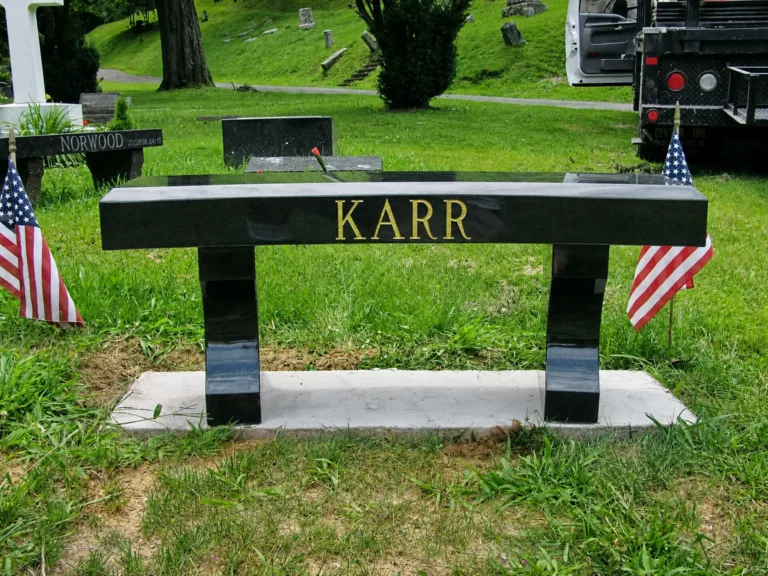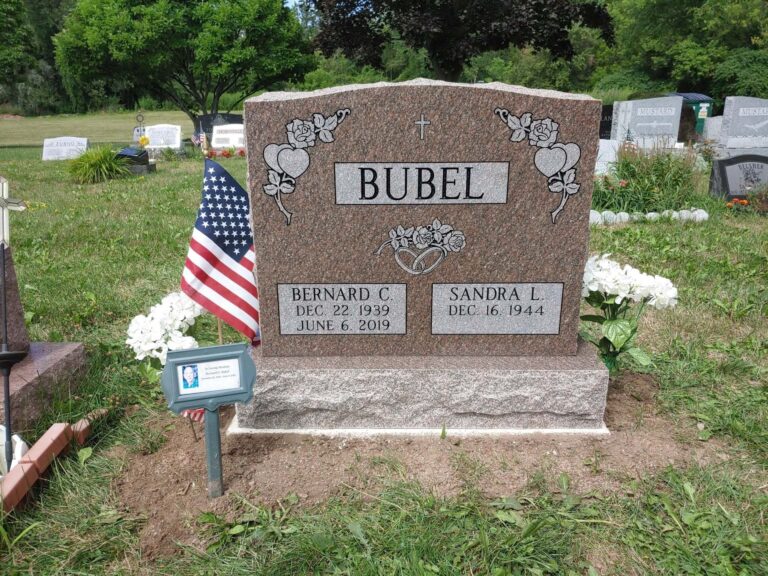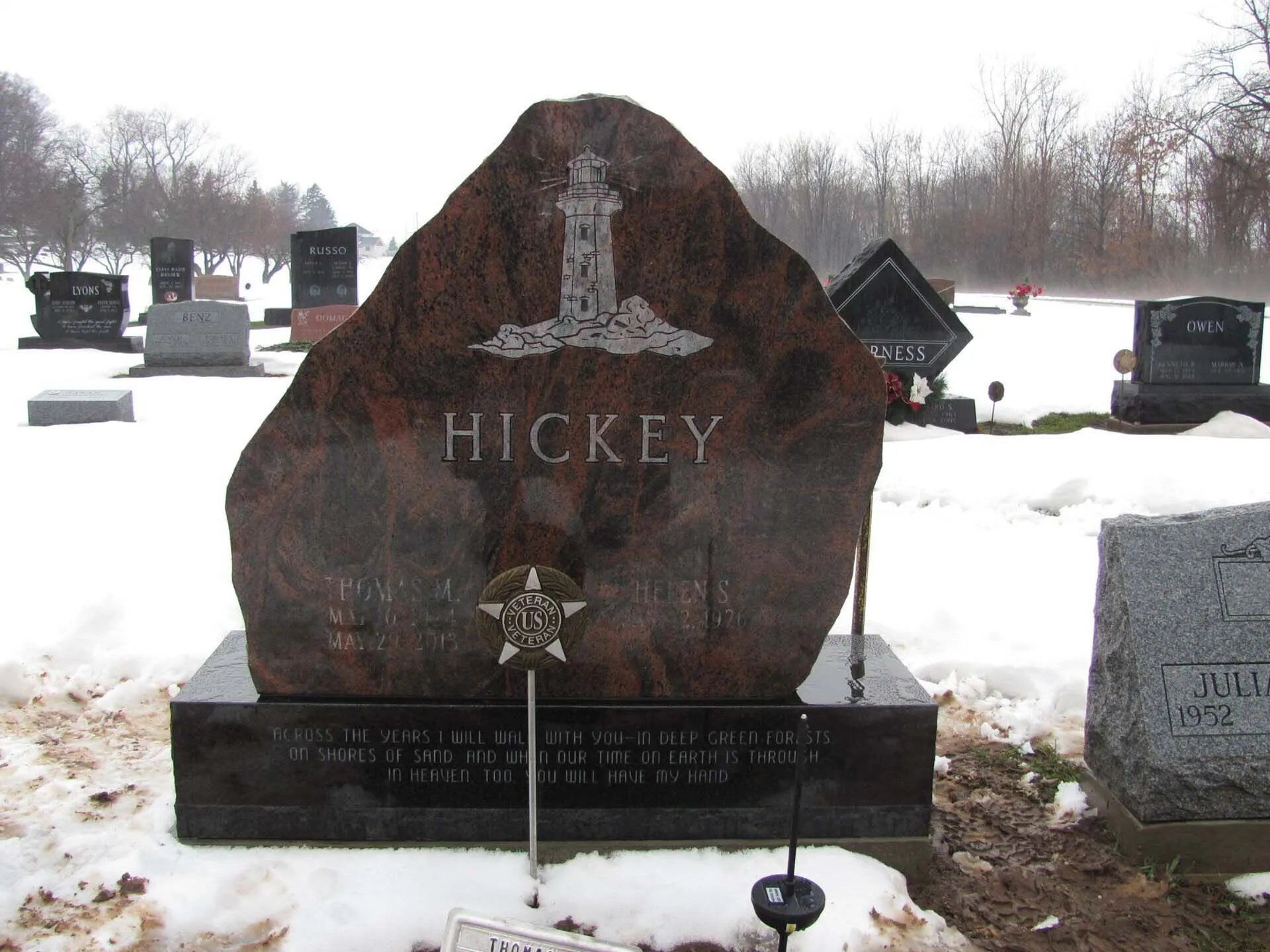
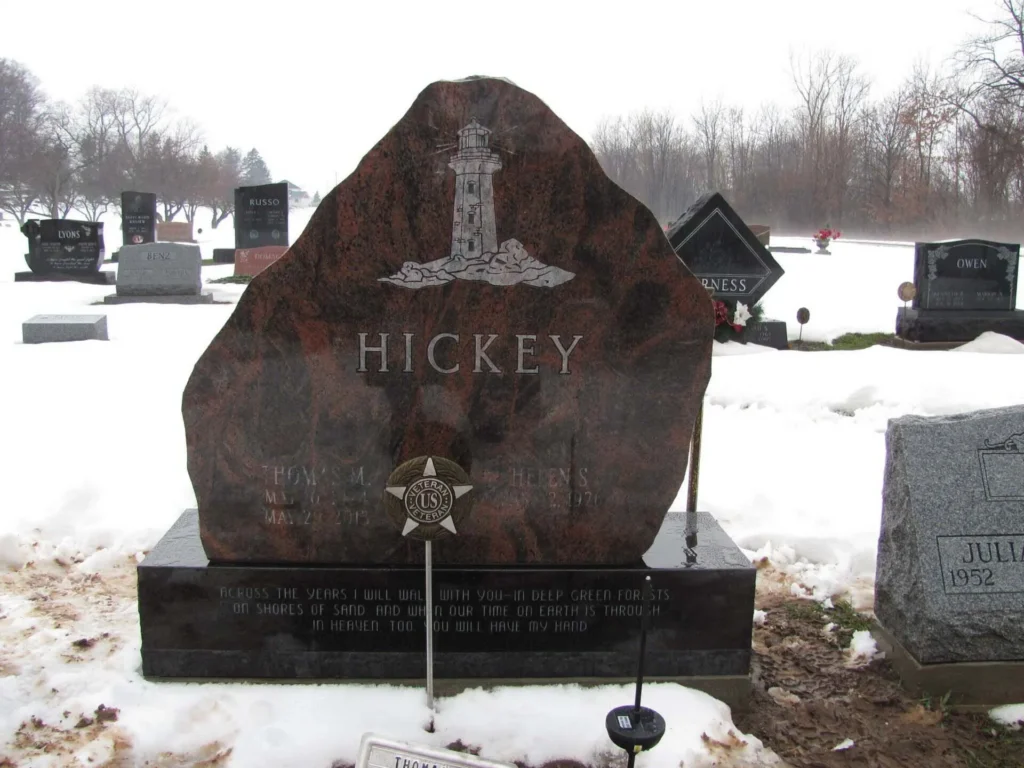
Shape, finish, lettering, symbol, and personal touches make up the five real layers of headstone design. Get familiar with each one and you can build something that actually looks the way you picture it, instead of settling for whatever a catalog shows first.
This guide sticks to the design and personalization side. It won’t walk you through picking a headstone type, comparing cost, or navigating cemetery rules, that’s covered elsewhere. Whether wording, budget, and cemetery approval are already settled, or you’re still forming a mental picture, everything below is about the creative decisions themselves.
We design every headstone in-house across four Western New York showrooms, so what follows comes from the people who actually carve the stone.
The Parts of a Headstone, Explained Simply
Most people notice two parts of a headstone without ever learning their names. The upright piece carrying the name and design is the tablet. The piece underneath holding it steady in the ground is the base. Larger monuments sometimes add a third piece for extra height.
The Tablet
The tablet is the part everyone actually looks at, the flat, upright face where the name, dates, and any inscription or artwork live. Tablets come in different thicknesses, and a thicker tablet tends to hold fine engraving detail better once decades of weather get involved.
The Base
The base does the quiet work of keeping the tablet from shifting or leaning over time. It’s usually wider than the tablet itself. Some designs put a second inscription here too, a family name across the front, separate from whatever’s carved into the tablet above.
Added Height and Tiered Designs
A middle tier between the base and tablet shows up on some upright monuments, adding height and a more layered look. It’s not part of every design. If that’s the look you want, ask your specialist whether it fits the shape and cemetery you’re working with.
Finish and Texture: The Look Beneath the Design
Light hits a headstone differently depending on how the granite is finished, and that changes how easily an inscription reads from a distance. Polished, honed, and natural or rustic are the three finishes families run into most often, and they can be mixed on a single stone rather than treated as an all-or-nothing choice.
Polished Finish
Polish gives granite a smooth, almost mirror-like surface once light catches it right. It’s the finish most people picture first when they think of a headstone, and it gives lettering and artwork the most contrast to work with.
Honed (Matte) Finish
Honing leaves the surface smooth but takes away the shine. Some families prefer it for exactly that reason. A honed finish has a quieter presence that settles into a cemetery setting rather than catching the eye from across the grounds.
Natural or Rustic Finish
A natural or rustic finish keeps some of the granite’s original texture instead of smoothing it away entirely. Families often use it on a base, a boulder, or one section of an otherwise polished design, closer to how the stone looked before it was shaped.
Lettering Style: How the Words Sit on the Stone
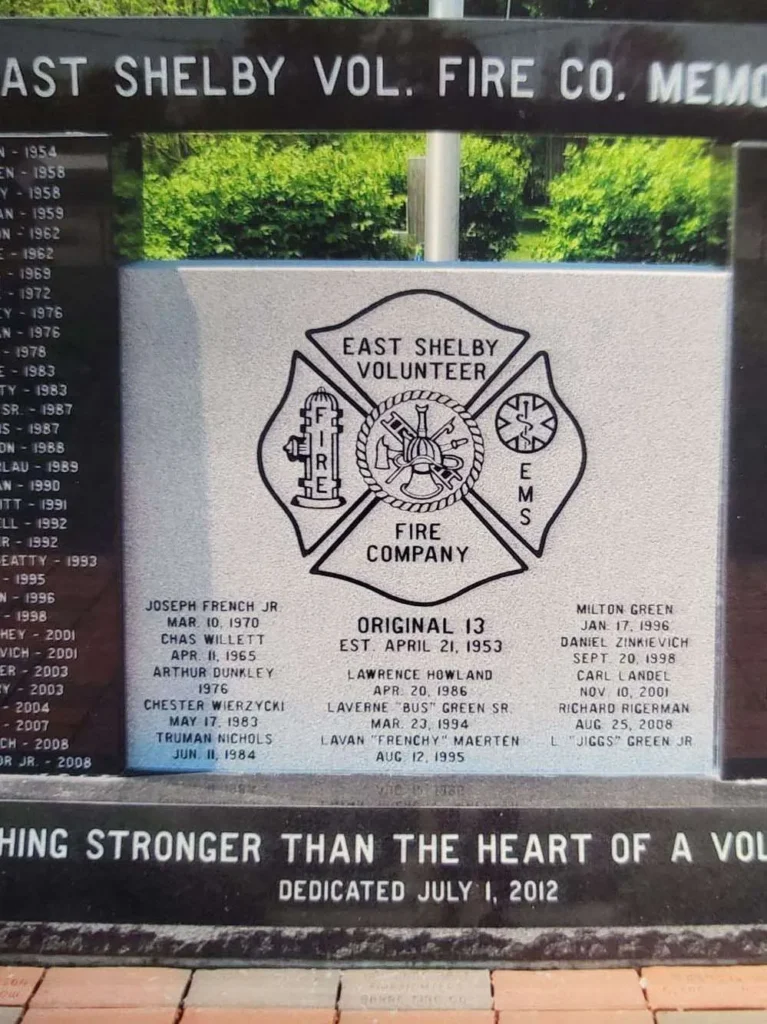
Lettering style comes down to how the letters sit against the granite, not which tool cut them. Raised and recessed are the two main approaches, and the font on top of that, script, block, or something more custom, changes the whole feel of a design.
Raised vs. Recessed Lettering
Raised lettering stands up off the surface, almost as if it was built rather than cut. It reads well from a distance and adds a bit of dimension. Recessed lettering does the opposite, cut down into the stone, and it tends to read as more classic and understated.
Painted or Filled Lettering
Recessed lettering is sometimes filled with paint, usually black or white, so the words stay sharp against the granite even in low light. It’s a small detail that makes a real difference on lighter-colored stone, where unpainted recessed letters can lose contrast in shade or overcast weather.
Script, Block, and Custom Fonts
Script feels personal and traditional, closer to handwriting. Block reads as cleaner and more modern. A few families ask for something more custom built around a specific look they already have in mind, and since nothing here gets outsourced, our in-house design process can take that on directly. Bronze lettering works a little differently, cast rather than carved, which matters if you’re adding new bronze plaques and lettering to an existing memorial instead of ordering a fresh granite tablet.
Beyond the Standard Shapes
Most families settle on one of four standard shapes, upright, flat, bevel, or slant, already covered at length in how to choose a headstone alongside cemetery rules and cost. Fewer people know what falls outside that list, and some of it carries more character than anything in a catalog.
Ledger Markers
A ledger marker covers the entire grave with one large, flat slab, wider and longer than a standard flat marker. It reads as more substantial without the height of an upright monument, and it suits a family who wants the whole plot to feel deliberately designed rather than just marked.
Heart, Scroll, and Cross-Top Silhouettes
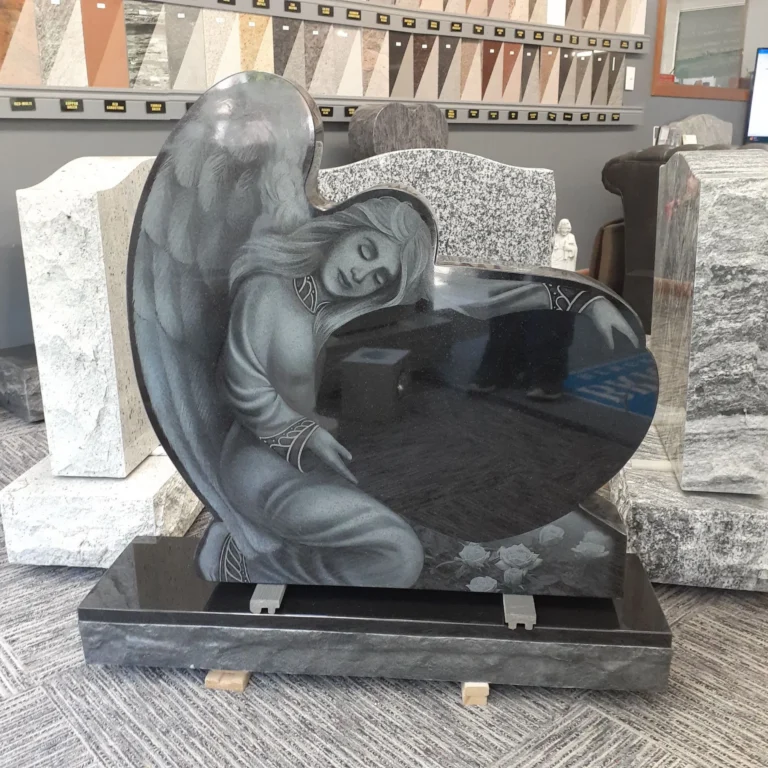
An upright shape doesn’t have to stay rectangular. A heart-shaped outline, a scroll-like curve at the top, or a cross cut directly into the silhouette instead of engraved onto a flat face, all carry meaning on their own, before a single word gets added.
Fully Custom Shapes
A fully custom shape starts from a family’s own idea instead of a catalog option. It takes longer to design and approve, since cemeteries vary widely in what they’ll accept for a non-standard silhouette, but for someone with something specific in mind, it’s usually worth the extra time. Tombstone shapes and styles rounds up more of these less common silhouettes for anyone still deciding.
Symbols as a Design Choice
A symbol on a headstone works like a sentence without any wording at all. Religious, natural, military, and fraternal symbols cover most of what shows up on modern memorials, and choosing one usually comes down to what represented the person best.
Religious and Spiritual Symbols
A cross, a Star of David, praying hands, or an open book are among the most familiar religious symbols, each carrying a meaning tied specifically to faith and belief. Older cemetery iconography goes further still, an anchor for hope, a broken column for a life cut short, and headstone symbols and their meanings works through the fuller list.
Nature and Personal Symbols
A tree, a dove, or a specific flower often stands in for something personal instead, a favorite place, a hobby, or a quality the family remembers most about someone. Unlike religious symbols, these don’t carry one fixed meaning, which is exactly why families reach for them to say something more individual.
Military and Fraternal Symbols
Military symbols mark service and rank. Fraternal symbols, a Masonic emblem, for instance, mark membership in an organization that mattered to the person. Both follow tighter design conventions than personal symbols do, since they’re meant to be recognized clearly by anyone who already knows what to look for.
Designing for a Specific Faith or Culture
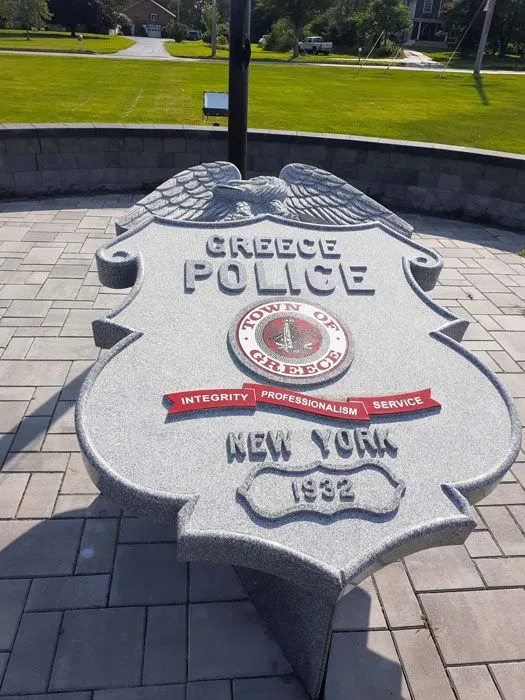
Faith and cultural background often shape a headstone’s design before a single symbol even gets chosen, through the overall silhouette, the layout, or motifs tied specifically to a tradition.
Christian and Catholic Motifs
A cross, a depiction of a saint, or a verse laid out in a traditional format shows up often in Christian and Catholic design. Some Catholic families go further and request imagery tied to a specific patron saint or their family’s parish, exactly the kind of detail Catholic headstone design covers in more depth, and our in-house process can lay it out from scratch rather than pulling from a fixed template.
Jewish and Other Faith Traditions
Jewish memorial design often centers on the Star of David or Hebrew lettering set alongside the English inscription. Every tradition brings its own symbols and layout conventions, and since design here starts from scratch rather than a preset template, we can lay out whatever a specific tradition calls for.
Secular and Non-Religious Designs
Not every family wants religious imagery on a memorial, and that’s just as valid a starting point. A secular design usually leans on nature symbols, a meaningful quote, or simply clean lettering with no symbol at all, letting the wording carry the whole design rather than sharing space with an emblem.
Adding a Photo: Ceramic, Porcelain, and Etched Portraits
A photo makes it onto a headstone one of two ways: a porcelain or ceramic plaque attached to the stone, or a portrait etched straight into the granite.
Porcelain and Ceramic Photo Plaques
A porcelain or ceramic plaque holds a full-color image sealed against weather and mounted directly onto the tablet. It’s faster and more affordable than etching, and it keeps the photo’s original color instead of translating it into black granite and light.
Etched Portraits
An etched portrait relies on light and contrast, pulling fine detail out of dark stone through shadow rather than color paint. Hand etching and laser etching handle that detail differently, allowing us to craft custom granite etchings that accurately capture your loved one’s photo.
Custom Sculptural Touches
A headstone doesn’t have to stop at the tablet. Vases, carvings, and small attached sculptures add texture and dimension beyond the flat inscribed surface.
Vases
A vase attached to the base or side of a monument gives a family somewhere to place fresh flowers on a birthday, an anniversary, or a visit that just needed one. It’s a small addition, but it turns a headstone into somewhere people can actively visit rather than just look at.
Carvings and Attached Sculptures
A carved detail set directly into the stone, or a small sculpture attached to the side or top of a monument, adds a level of personalization a flat inscription can’t reach on its own. These take longer to design and produce than a standard engraving, since each one gets built around a specific idea, and custom and personalized headstones walks through more of what’s possible.
Putting It Together: Matching a Design Style
Shape, finish, lettering, and symbol don’t have to be chosen one at a time with no relationship to each other. Designs that feel intentional, rather than assembled piece by piece, tend to land in one of three general directions.
Traditional and Classic Looks
An upright shape, a polished finish, recessed block or script lettering, and a religious or family symbol placed simply at the top or corner of the tablet, that combination has stayed common for generations for a reason. It reads clearly and ages well.
Modern and Minimalist Looks
A flatter or lower profile, a honed rather than polished finish, and minimal ornamentation, sometimes just a name, dates, and a single small symbol, define a more modern look. The restraint is the point. Less on the stone puts more weight on what’s actually there.
Rustic and Natural Looks
Natural or partially polished finishes, sometimes a boulder or a ledger shape instead of a standard tablet, and lettering that feels hand-carved rather than machine-precise, all point toward a rustic look. It suits a family drawn to something closer to nature than to a showroom catalog.
Bringing Your Design to Life
Once shape, finish, lettering, and symbols come together, the process shifts from design to logistics. Cemetery approval, pricing, and timeline take over from there, and our walkthrough on how to choose a headstone covers all three alongside material comparisons.
Some families like to sketch out an early version of their design before sitting down with a specialist in person. If that’s more your speed, ask your showroom which design tool option currently applies, we’re in the process of consolidating that into a single starting point.
Frequently Asked Questions About Headstone Design
What is the most popular headstone design right now?
Upright monuments with a polished finish and a simple religious or family symbol remain the most common choice for new memorials. Flat and slant markers have grown more common too, mostly in cemetery sections that restrict height, so “most popular” increasingly depends on what a specific cemetery allows before it depends on personal preference.
Can more than one finish be used on the same headstone?
Yes. Pairing a polished tablet with a honed or natural base is common, and so is leaving one carved section unpolished to make it stand out against the rest of the stone. Mixing finishes is a design choice, not a limitation.
Do headstone symbols have to be religious?
No. Nature symbols, hobbies, and personal interests show up on memorials just as often as religious imagery does. A symbol only needs to represent something true about the person, it doesn’t need a fixed traditional meaning to belong on the stone.
Can a custom shape still meet a cemetery’s rules?
Sometimes, and sometimes not. Cemeteries vary widely in what non-standard shapes they’ll approve, which is why a custom silhouette needs cemetery sign-off before production starts, not after a design is already finalized.
Can a photo be added to a headstone years after it’s installed?
In most cases, yes. A porcelain photo plaque or an etched portrait can often be added to an existing memorial, though the stone’s finish and available space affect what’s possible. It’s worth having a specialist look at the specific headstone before ruling either option out.