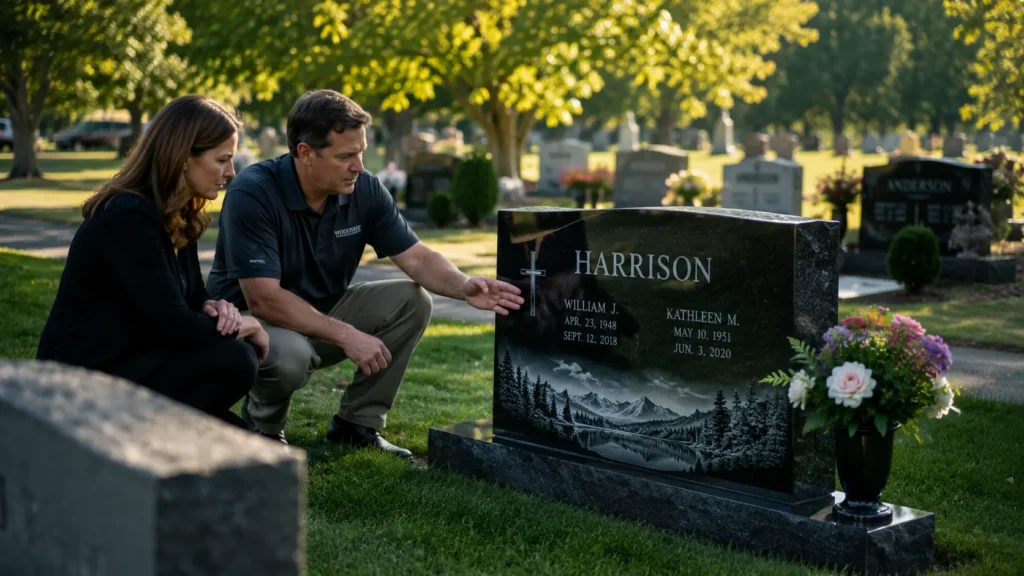
Most people picture a single stone standing at the head of a grave. That’s the most familiar option, but it’s not the only one.
There are seven main types of headstones and grave markers available to families: upright monuments, flat markers, slant markers, bevel markers, ledger stones, memorial benches, and memorial boulders. Mausoleums and columbariums serve families choosing above-ground interment or cremation. Each type differs in height, visibility, the amount of space available for personalization, and whether a given cemetery section allows it at all. Granite is the most durable material for all of them.
Starting with a basic understanding of what each type looks like, and who usually chooses it, makes the rest of the process much easier. You’ll also have a better idea of what to ask when you talk with your cemetery or monument company.
The Most Common Types of Headstones
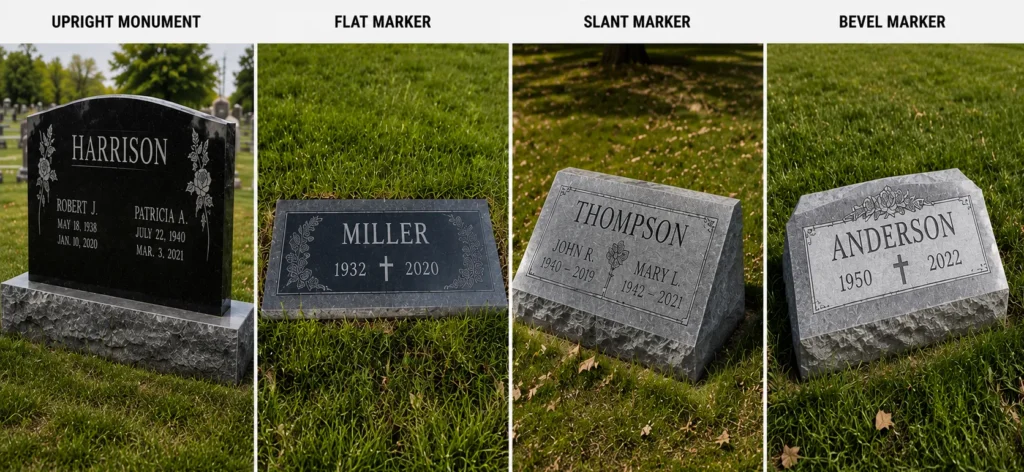
These four types are what most families encounter when they start looking.
Upright Monuments
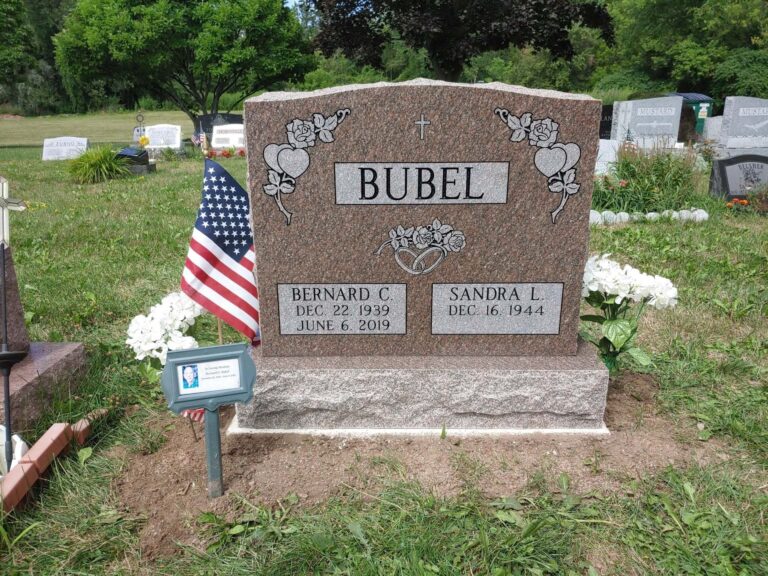
An upright monument has two parts: the die and the base. The die is the vertical section that displays the name, dates, and any inscription or artwork. The base is the horizontal piece the die sits on. Together, that’s what most people picture when they think of a traditional grave monument.
Standard upright monuments range from 20 to 42 inches tall, depending on what a cemetery’s section allows. Companion versions, which memorialize two people side by side on one stone, typically run 36 to 48 inches wide.
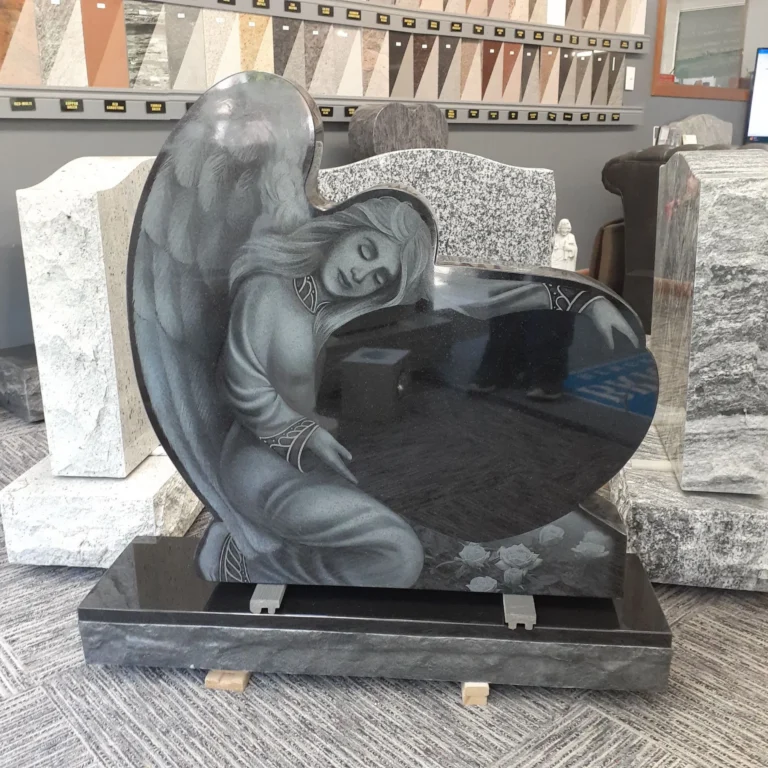
The top edge of the die can be shaped several ways. The serpentine top, which has a gentle S-curve, is the most popular. Other common options include oval tops, rooftop (peaked), flat tops, and corner rounds. Custom shapes, like hearts, crosses, or open books, are also available, though they add fabrication time.
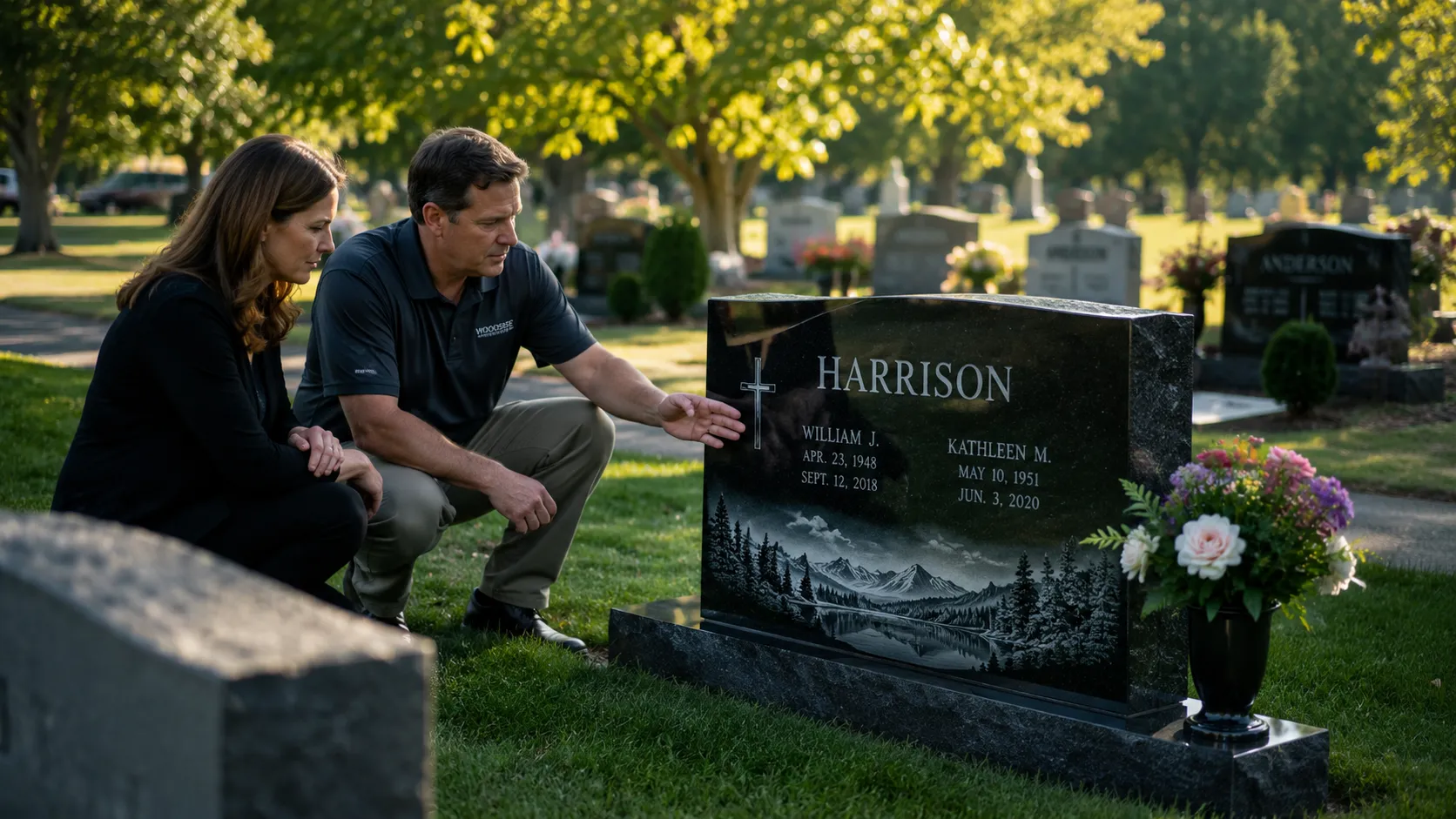
Upright monuments give families the most room for personalization. If you want a portrait etched into the stone, or a detailed scene that reflects something meaningful about who the person was, this is the type that has the surface area for it. All hand etching is done in-house by our artist-in-residence Melissa Trinidad, and that kind of detailed portrait work translates best to the smooth, polished face of an upright.
One practical thing to know: upright monuments require a concrete foundation. In climates with a hard winter frost, most cemeteries wait until after the spring thaw to pour those foundations, so installation typically lands between April and late spring. If you’re ordering in winter, that timeline is normal and expected.
Flat Markers
Flat markers lie at or just slightly above ground level. There’s no separate base. The whole marker is a single slab, usually 4 inches thick, set into a concrete foundation that keeps it flush with the lawn.
Common sizes for a single grave are 24 by 12 inches or 28 by 16 inches. Companion markers typically run 44 by 14 inches.
Flat markers come in granite or bronze. Both hold up through years of freeze-thaw weather. Granite flat markers can be polished and laser-engraved with names, dates, symbols, and artwork. Bronze markers develop a natural patina over time that many families prefer.
Sometimes the cemetery makes this decision before the family does. Many modern memorial parks require flat markers across entire sections to simplify grounds maintenance and mowing. If your loved one is buried in one of those sections, the type is already set. But flat markers are also a deliberate choice for families who want something low-profile and easy to maintain, or for anyone who needs a marker quickly while a more permanent design is being completed.
Slant Markers
A slant marker sits somewhere between a flat marker and a full upright. The back edge stands 12 to 18 inches tall, and the front face angles down toward the ground. From the side, it has a triangular shape.
Most slant markers have what’s called nosing: a flat 2-inch ledge running along the bottom of the front face. The nosing provides a stable footing and allows the marker to be set directly on a concrete foundation without needing a separate granite base. Full-face slant markers don’t have nosing; those typically sit on a small granite base or vase.
The angled face makes the inscription easier to read from a standing position. That’s more useful than it might sound, especially in winter. A flat marker can disappear under a few inches of snow. A slant marker stays visible year-round.
Slant markers work for single or companion burials and can be engraved with custom artwork just like uprights. They’re a solid middle option when you want more visibility than a flush marker but don’t need the full height of a standing monument.
Bevel Markers
A bevel marker is sometimes called a pillow headstone because of its profile. It’s flat at the bottom and slopes upward slightly toward the back, like a wedge. Bevel markers are thicker than standard flat markers, typically 6 inches instead of 4 inches.
They sit a few inches above the ground, which makes them more visible than flush markers while still keeping a low, contained shape. In sections with height restrictions, they work where uprights don’t.
Bevel markers are a reasonable fit for families who want something slightly more prominent than a flat marker without spending more on a full upright. Personalization options are similar to flat markers: name, dates, symbols, and shorter inscriptions all work well on the angled face.
One thing to confirm before ordering: some cemeteries classify bevel markers separately from standard flat markers and apply different dimension limits to them. Check with your cemetery first.
Larger and Specialty Memorial Types
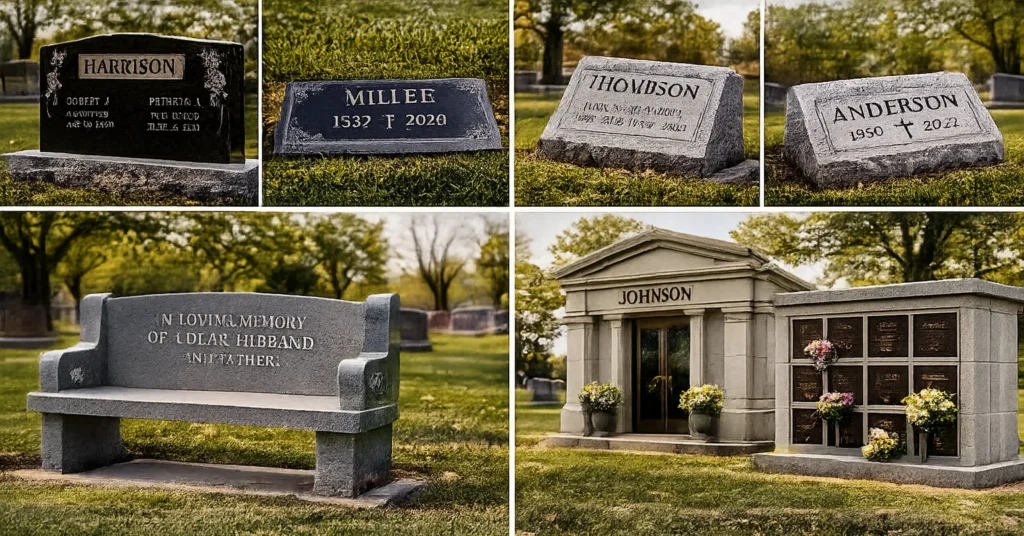
Beyond the four standard marker styles, some families choose something built for a different scale or purpose.
Memorial Benches
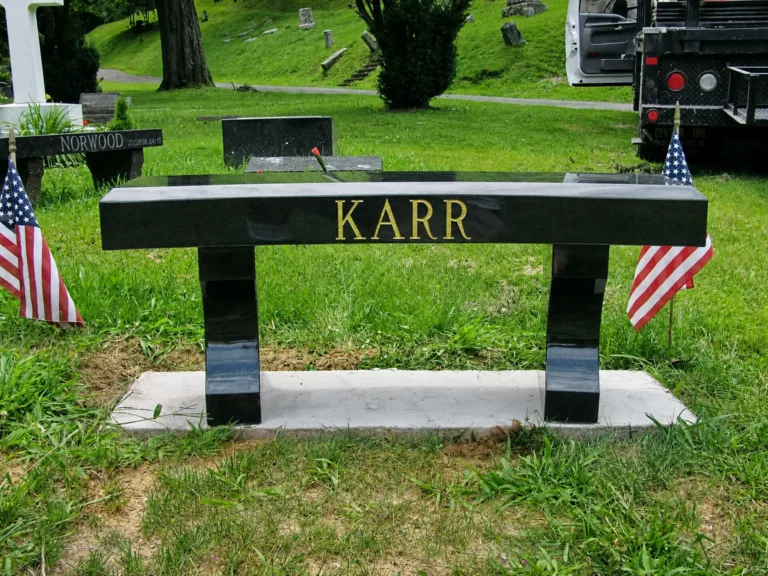
A memorial bench is a full granite bench that also functions as the grave marker. The name, dates, and inscription appear on the backrest, the seat, or both.
Families choose benches when they want a place to actually sit during visits. Rather than standing at a stone, you can sit with your loved one for a while. That matters to a lot of people. Memorial benches are also used for cremation interment, since the granite pedestal can house an urn beneath the seat.
We offer traditional memorial benches and cremation benches. They don’t require a separate base the way uprights do, and they’re often permitted in cemetery sections that accept a wider range of monument styles.
Ledger Stones
A ledger stone is a large, flat slab that covers most or all of the length of a grave. It lies horizontally, similar to a flat marker, but it’s much larger in size.
Families use ledger stones when they want significantly more room for text: a longer epitaph, family genealogy spanning several generations, or an extended personal message. They’re also common in family plots where multiple burials share a single space. Because ledger stones require far more granite than a standard marker, they cost more. They’re less common in single-plot sections, but in older cemeteries or family plots, they’re a dignified and lasting choice.
Mausoleums
A mausoleum is an above-ground structure that holds the remains of one or more people. A private family mausoleum is built on cemetery property, typically for one or two individuals. Larger community mausoleums share a building with individual crypts inside.
When a family chooses a mausoleum, there’s no separate headstone or flat marker placed over a grave. The granite or marble front panel of the structure itself serves as the memorial, with the name, dates, and inscription built into it.
We design and install custom mausoleums. If your family is considering above-ground interment, that’s a conversation worth starting with one of our specialists before you make any commitments with the cemetery.
Columbariums
A columbarium is a structure with individual niches, each designed to hold a cremation urn. The front of each niche has a small nameplate or marker panel with the person’s name, dates, and sometimes a brief inscription.
Families choose a columbarium niche instead of ground burial, particularly after cremation, when they want a permanent and accessible place for the remains. Columbariums range from small two-niche family units to large multi-row installations for a cemetery or church. We install both scales.
A Note on Memorial Boulders
A memorial boulder is a natural granite boulder with one face sawn flat and engraved. The surface can be polished or left with its natural unfinished texture, which gives it a look that blends into a garden or natural burial setting rather than reading as a traditional cemetery stone.
Families who want something outside the usual choices, and whose cemetery allows it, sometimes find that a boulder fits perfectly. We’re one of the few monument companies that offers them. If you’ve seen one and wondered what it was, that’s what it is.
Granite, Bronze, and Marble

The type of marker you choose affects which materials make practical sense. Here’s how the three main ones compare.
- Granite is the standard choice for most memorial types, and for good reason. It’s hard, weather-resistant, and holds polish and engraved detail for generations. It doesn’t absorb water the way softer stones do, which matters when temperatures drop below freezing and rise again repeatedly through a cold winter. We carry more than 90 named granite colors, including Academy Black, Bahama Blue, and Dakota Mahogany. The color your family has in mind is likely in that catalog.
- Bronze is most often used as a plaque mounted on a granite base. The combination is visually distinct, and bronze develops a natural protective patina over time. The Department of Veterans Affairs provides flat bronze markers at no cost to eligible veterans, mounted on a granite base that families arrange separately. We also produce custom bronze plaques and can add bronze lettering to an existing stone.
- Marble has been used in cemeteries for centuries and has a classic appearance that many families appreciate. It’s also softer than granite, which means it weathers faster in a cold climate with significant winter moisture. Inscriptions on marble can become harder to read over time as the surface slowly erodes. Most families who want a marker that stays legible and low-maintenance for generations choose granite. That’s not a knock on marble; it’s an honest tradeoff.
What the Cemetery Decides Before You Do
This is the part most families don’t find out until they’re already attached to a particular style.
Every cemetery sets its own rules about what markers it permits, and those rules often vary by section within the same cemetery. Some sections allow upright monuments. Others, especially in modern memorial parks, are flat-marker-only. A family can spend weeks settled on an upright monument and then learn that the section where their loved one is buried doesn’t permit them.
Before you choose a type, confirm these things with your cemetery directly:
Does this section allow upright monuments, or only flat markers? What are the maximum dimensions permitted for this section? Are vases allowed? (Some cemeteries require them; others restrict them seasonally.) Are porcelain or ceramic photo memorials permitted here? Who sets the foundation: the cemetery or the monument company?
In climates where the ground freezes, most cemeteries delay foundation installation until after the spring thaw. A monument ordered in January may not be installed until April or May. That timeline isn’t slow production. It’s standard cemetery process, and it’s set by the cemetery, not by us.
Figuring all of this out while grieving is hard. We handle the cemetery coordination directly for families who work with us. We confirm what the section allows, submit the required paperwork, and schedule with the cemetery so that step doesn’t fall on you.
Which Type Is Right for Your Family
There’s no single correct answer. The right type depends on what the cemetery allows, how much personalization matters to you, and what fits your budget.
- Upright monument: The best fit when your cemetery section allows uprights and you want maximum space for a portrait, custom artwork, or a longer inscription. It’s the type with the most surface area and the most flexibility in design.
- Flat marker: Required in many modern cemetery sections. Still allows meaningful personalization through engraving, symbols, and artwork. A good choice for families who want something understated, or who need a marker on a tighter timeline.
- Slant or bevel marker: Worth looking at when you want more visibility than a flat marker but the section doesn’t permit a full upright. Both sit above ground level and are easier to read from a standing position than a flush marker.
- Memorial bench: A natural choice when sitting together at the grave matters to your family, or when cremation is involved. More families choose benches than most people realize.
- Mausoleum or columbarium: For families considering above-ground interment or cremation niche placement. No separate grave marker is needed; the structure itself serves as the memorial.
Frequently Asked Questions
What is the most common type of headstone?
Upright monuments are the most traditional and widely chosen type in the United States. They consist of a vertical tablet on a granite base and offer the most space for names, dates, artwork, and inscriptions. In most American cemeteries, they’re the default choice when the section permits them.
What’s the difference between a flat marker and a bevel marker?
A flat marker lies flush or nearly flush with the lawn. A bevel marker is thicker, typically 6 inches, and slopes upward slightly toward the back. That angle raises the face a few inches above the ground, making it a bit more visible from a standing position than a flat marker. Both are commonly chosen in sections where upright monuments aren’t allowed.
Does the cemetery decide what type of headstone I can use?
Yes, in part. Every cemetery has its own rules about permitted types, materials, sizes, and finishes. Some cemetery sections are flat-marker-only. Before you choose a type, confirm with your cemetery what’s allowed in the specific section where your loved one is buried. If you work with us, we handle that step directly so you don’t have to navigate it alone.
What type of headstone holds up best over time?
Granite performs best in climates with cold winters and regular freeze-thaw cycles. It’s dense enough to resist water absorption, holds its polish over decades, and doesn’t chip or erode the way softer stones do through repeated cold seasons. A properly installed granite monument with the right concrete foundation depth for local frost requirements can stand unchanged for a century or more.
Can I choose a headstone before someone passes away?
Yes, and many families do. Pre-planning a memorial means you choose the type, material, color, and design without any time pressure. It removes a difficult decision from an already difficult time. You can look through your options and get a free estimate without any obligation to finalize anything on the spot.