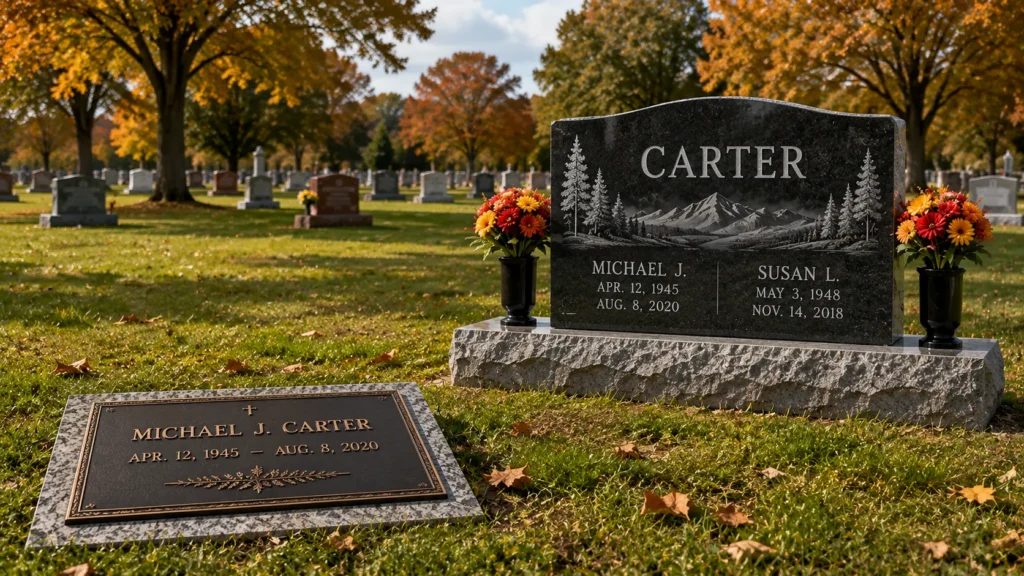
Most families assume the choice between a flat marker and an upright monument comes down to taste or budget. In practice, the cemetery decides first. Some cemetery sections only allow flat markers, others only allow upright stones, and that single rule eliminates half the decision before cost or design ever enters the conversation. Once that’s settled, what’s left is visibility, how much room you have to tell a fuller story, what each style actually costs to install, and how the two hold up through a Western New York winter.
| Flat Marker | Upright Monument | |
|---|---|---|
| Position | Level with the ground | Vertical, on a separate base |
| Typical size | 16″x8″ up to 24″x12″ (larger for companion markers) | 20″ to 48″+ in height |
| Visibility | Low, hidden under snow in winter | High, visible year-round |
| Personalization | Name, dates, short phrase, simple symbol | Portraits, epitaphs, etching, lettering on the back |
| Maintenance | More frequent cleaning, no leaning | Occasional releveling, less surface buildup |
| Typical cost | Lower, less material and simpler installation | Higher, needs a foundation and more granite |
| Best for | Budget-conscious, understated, strict mowing sections | Visibility, multi-name monuments, detailed artwork |
What Is a Flat Headstone?
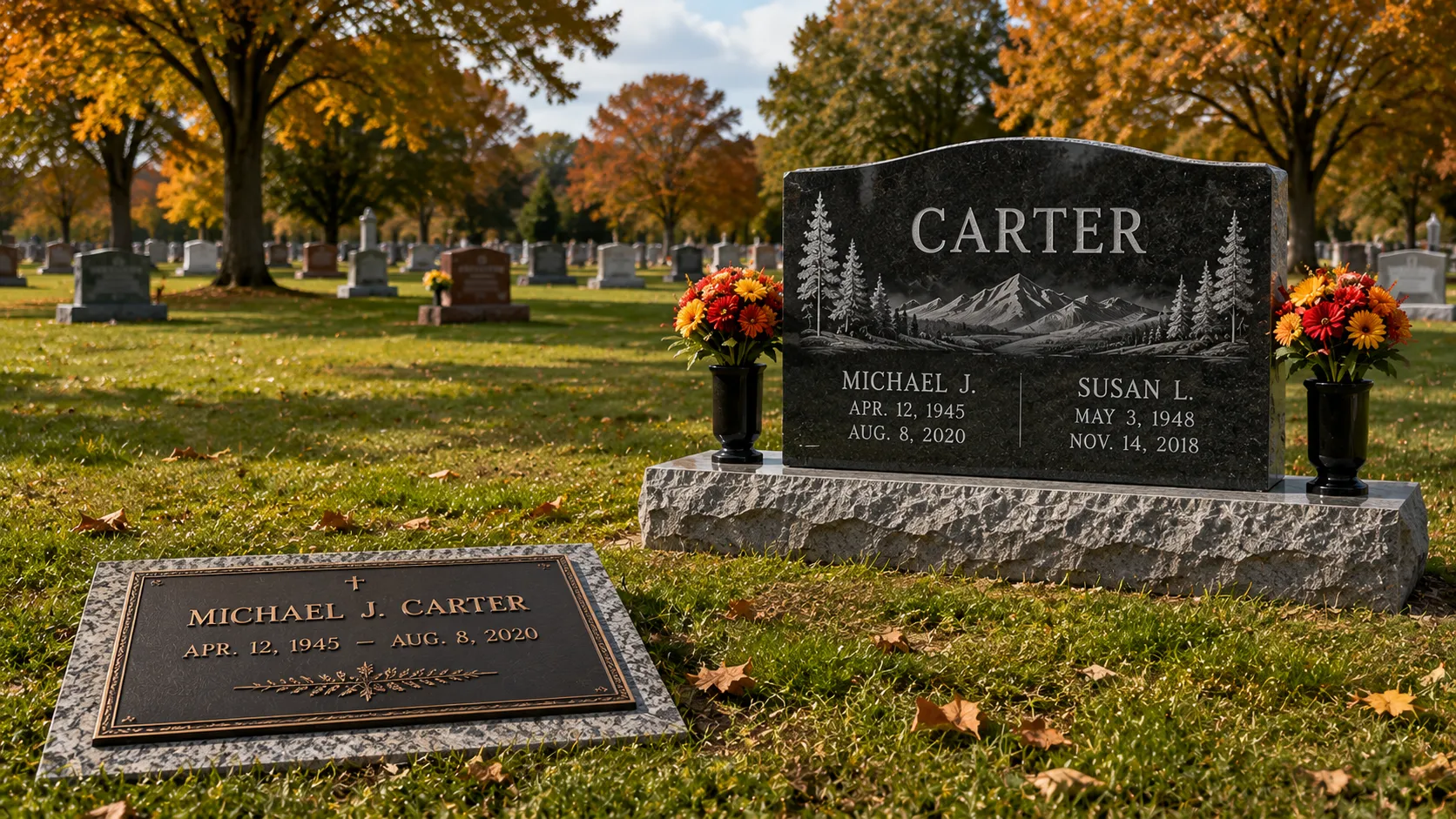
A flat headstone, also called a flat marker, grass marker, or flush marker, sits level with the ground or just slightly above it. Most single flat markers run somewhere in the range of 16 by 8 inches up to about 24 by 12 inches, with companion markers for two names running closer to 44 by 14 inches. Granite is the standard material, though bronze plaques set into a granite or concrete base are common too, and some families mix the two for a different finish on the lettering.
Because they sit at ground level, flat markers create a uniform look across a cemetery section, which is exactly why so many newer memorial parks require them. Mowing crews can pass right over the stone without slowing down, and the lower profile means less surface exposed to weather on all sides.
A close relative worth knowing about is the bevel marker. It looks similar to a flat marker, but the top edge is cut on a slight angle, which lifts the lettering just enough to catch light and shadow differently. Cemeteries that allow flat markers almost always allow bevel markers too, so it’s worth seeing both in person before deciding between them.
What Is an Upright Headstone?
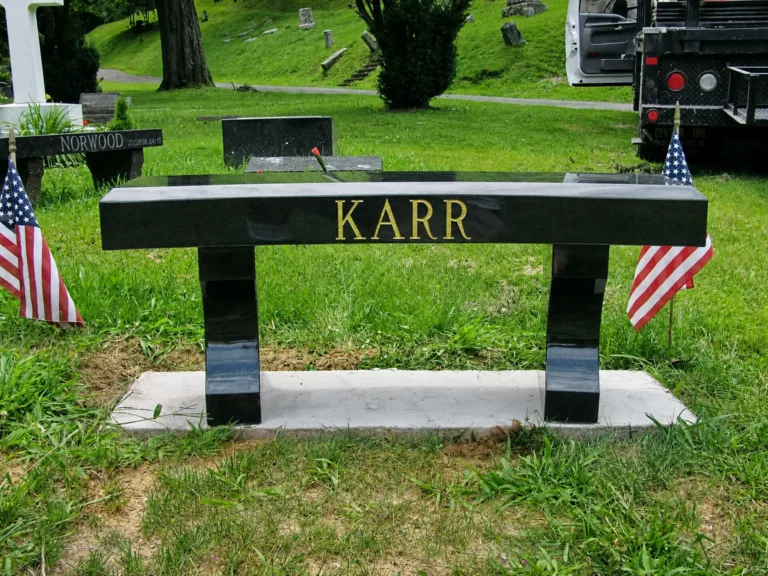
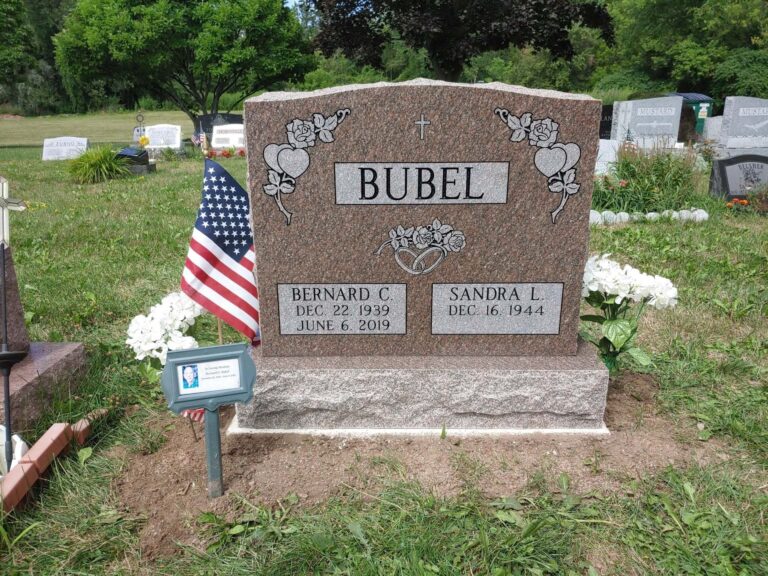
An upright headstone, often just called a monument, stands vertically on a base. It has two parts: the die, which is the vertical slab that carries the engraving, and the base, which anchors it to the ground. Heights commonly range from around 20 inches for a modest single marker up to 48 inches or more for a larger family monument, and the top of the die can be cut into different shapes, serpentine, oval, or flat-topped being the most common.
Upright monuments are the style most people picture when they hear the word “headstone.” They’re harder to miss from across a cemetery, and many designs also allow lettering on the back of the stone, which effectively doubles the space available for a second name, a longer epitaph, or additional artwork.
Check Your Cemetery’s Rules First
Cemetery policy decides more of this choice than most families expect. Some cemeteries, particularly newer memorial parks, only permit flat markers to keep the grounds uniform and easy to maintain. Older or traditional cemeteries tend to allow upright monuments, sometimes with restrictions on height or material. A few cemeteries split the difference, designating certain sections for flat markers and others for upright stones.
This is the first thing to confirm, not the last. If a family falls in love with a tall granite monument before checking, and the cemetery only allows flat markers, that conversation gets harder than it needs to be.
At Woodside Granite, we work directly with each cemetery’s office before any design moves forward. That means confirming what’s allowed at Holy Sepulchre Cemetery next to our Hart Monument Company showroom in Rochester, or at any cemetery across Albion, Warsaw, and Batavia, so a family never finds out the rules after they’ve already chosen a design.
What Drives the Cost Difference
Flat markers are generally the more affordable option, mainly because they use less material and require simpler installation. Upright monuments cost more because they need a larger piece of granite, a separate base, and a poured foundation to keep the stone stable for decades.
Beyond the basic style, price moves with size, granite color, lettering complexity, and any added artwork like a portrait etching or a porcelain photo. Two upright monuments can look similar from a distance and still cost very differently once you factor in the design work behind them.
Because every memorial we build is custom, we don’t publish a flat price list. The honest answer is that it depends on what you’re picturing, which is exactly why we offer a free estimate before anyone commits to anything. Financing is also available for families who’d rather spread the cost out than pay it all upfront.
Personalization and Design Space
Flat markers give you a clean, horizontal surface, enough room for a name, dates, a short phrase, and a simple symbol like a cross or a military emblem. Veterans and their families should also know that the VA provides flat markers at no cost for eligible service members; we cover what that involves in more detail in our guide to VA headstone benefits.
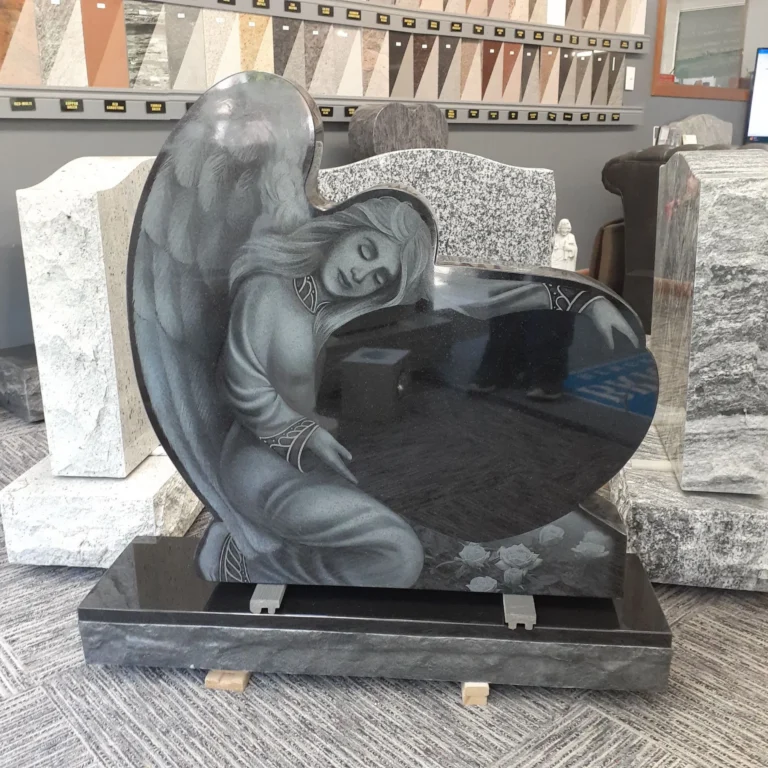
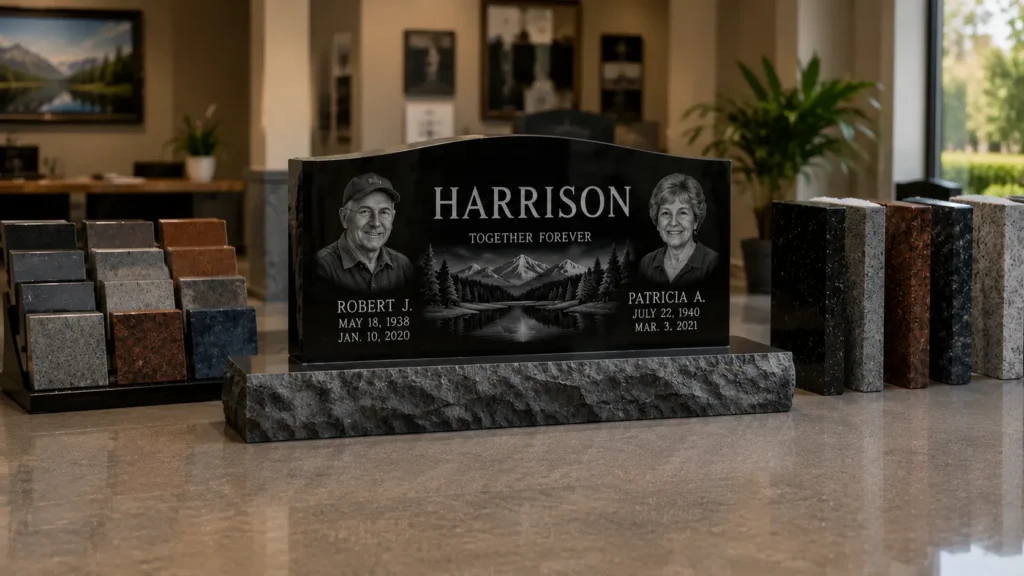
Upright monuments give you considerably more room to work with. We design and letter every monument in-house, and our hand and laser etching is done by Melissa Trinidad, our Artist-in-Residence, who works in portraits, farm scenes, and fully custom artwork on dark granite. Families who want a photo rather than an etching can add a porcelain photo to either style.
Granite color plays into this too. We carry more than 90 named granite colors across all four showrooms. Color affects how legible an engraving stays decades from now just as much as it affects the initial look.
Maintenance in a Western New York Winter

Granite holds up well in any climate, but flat and upright markers wear differently here specifically because of our freeze-thaw cycles. Ground shifts through winter can cause an upright stone to lean or settle unevenly over the years, which sometimes calls for releveling. Flat markers don’t lean, but they sit closer to where biological growth and staining build up, so they tend to need cleaning more often to stay legible.
There’s a seasonal trade-off too. Once snow covers the ground, a flat marker can disappear completely until spring, while an upright stone usually stays visible all winter. For families who visit often, that’s worth thinking about before you decide.
Either way, granite itself doesn’t wear out on a human timescale. What changes over the decades is the ground underneath it and how much attention the surface gets. If a monument ever does develop cracking, tilting, or staining, that’s a restoration question rather than a reason to start over. We cover what that process looks like in our guide to monument cleaning and freeze-thaw damage.
What About Slant Markers?
Somewhere between flat and upright sits the slant marker, angled at the front and standing roughly 12 to 18 inches tall at the back. It offers more visibility than a flat marker without the cost or footprint of a full upright monument, and most cemeteries that allow uprights will accept a slant as well. If that middle option sounds closer to what you’re picturing, our full guide to slant markers covers it in more detail.
Which One Fits Your Family?
If your cemetery only allows one style, the decision is already made, and there’s no reason to spend much time deciding which memorial to choose. Outside of that, the choice usually comes down to two things: how much you want the memorial to be noticed from a distance, and how much room you want for telling a fuller story.
Families on a tighter budget, or who simply want something quiet and understated, tend to lean toward a flat marker. It does the job without asking for attention, and it stays easier to keep tidy season after season. Families planning ahead rather than reacting to a recent loss often land here too, since a flat marker fits cleanly into a pre-need budget. Our guide to pre-need versus at-need planning gets into that timing question in more depth.
An upright monument tends to make more sense for a family that wants the memorial easy to find, wants more than one name on it, or has a story that needs more than a few lines to tell properly. It’s also the better fit if you visit through the winter and don’t want the marker buried under snow until spring.
Frequently Asked Questions
Is choosing a flat headstone less respectful than choosing an upright one?
No. The style you choose says nothing about how much you cared. Plenty of families pick a flat marker because the cemetery requires it, because it fits their budget, or simply because they prefer something quiet. A simple flat marker, well chosen, honors someone just as fully as a tall monument does.
Do flat headstones sink into the ground over time?
A well-installed flat marker, set on a proper base or foundation, shouldn’t sink or shift in any noticeable way. When families do see a marker settle unevenly, it’s almost always tied to a rushed or shallow installation rather than the marker itself. That’s part of why we handle the foundation work ourselves instead of leaving it to the cemetery crew.
Why do some cemeteries only allow flat markers?
Mostly maintenance. Flat markers let mowing equipment pass over a section without obstruction, which keeps grounds-keeping costs down and gives the cemetery a uniform appearance.
Can I switch from a flat marker to an upright monument if cemetery rules change later?
Sometimes, but not always. Many cemeteries set rules by section rather than by individual plot, so an existing flat-marker section usually stays that way even if the cemetery allows uprights elsewhere. It’s worth confirming with the cemetery office before assuming either way.
Does a flat marker cost less to install than an upright monument?
Generally yes, since uprights require a poured foundation and a separate base in addition to the stone itself. Exact installation costs vary by cemetery, which is part of why we walk through it during a free estimate rather than quoting a flat number online.
Can a flat headstone include a photo or religious symbol?
Yes. Flat markers can include porcelain photos, religious symbols, and military emblems. The design space is just smaller than what an upright monument offers.