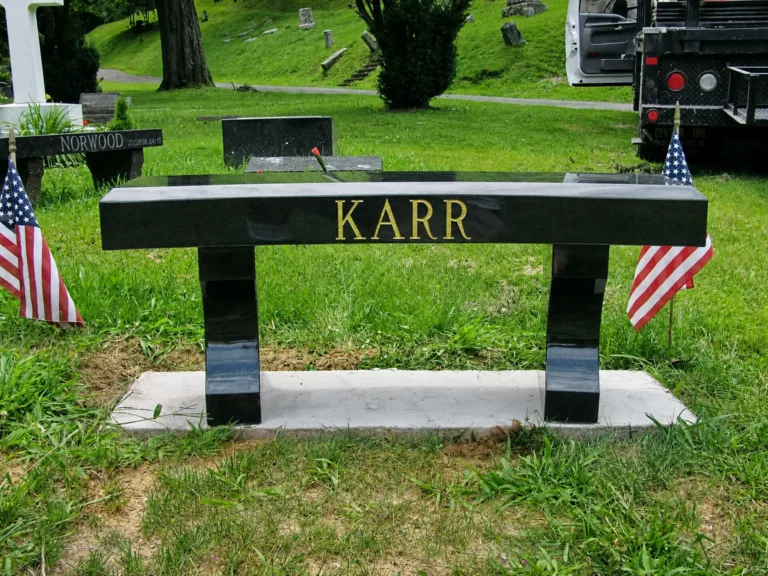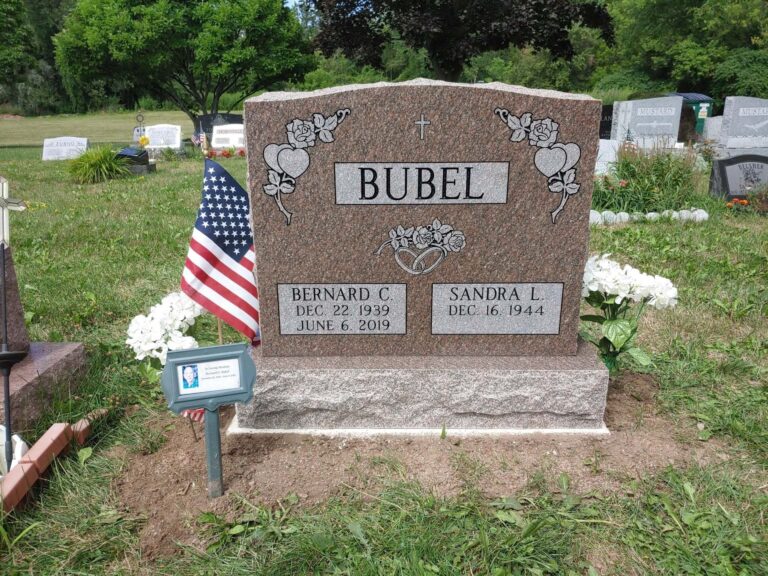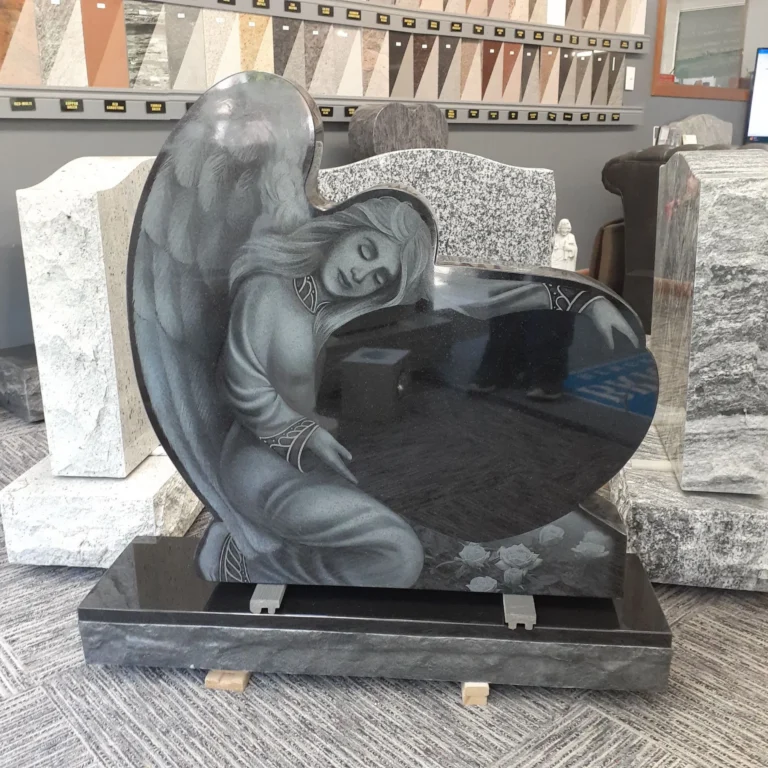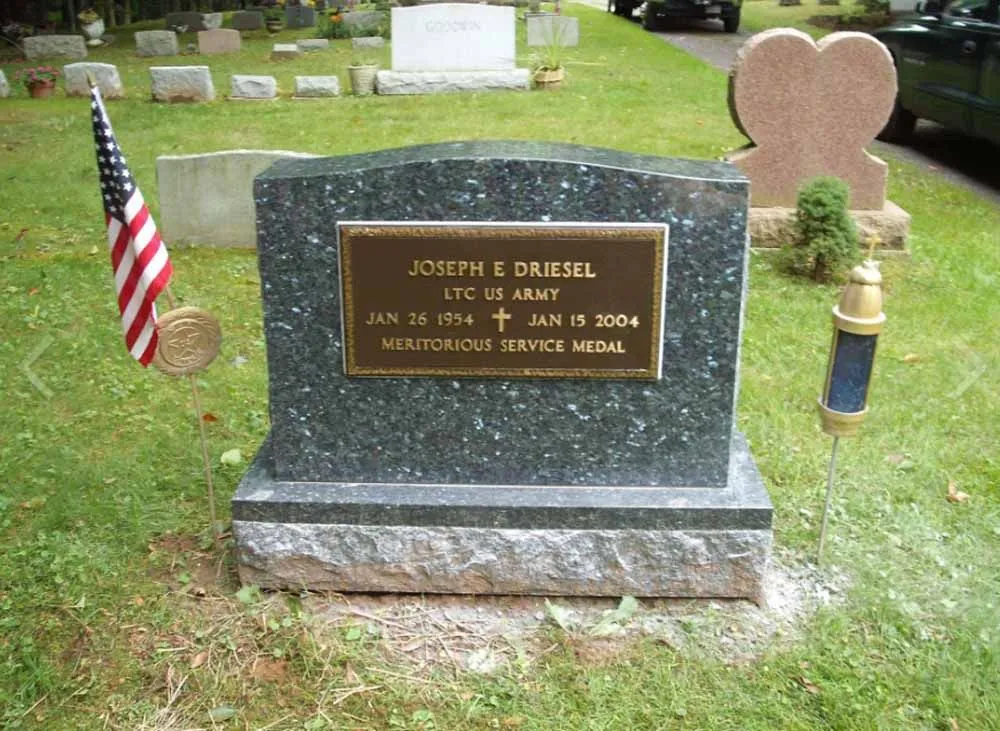
Polished, honed, and rock pitched. When a monument specialist asks which surface finish you want, these are the three options on the table, and each one has practical consequences most families don’t fully anticipate until they’re reviewing the order form.
Polished gives the stone a mirror-like sheen and brings out its full colour. Honed produces the same smooth surface but completely matte, with no reflective quality. Rock pitched is rough and hand-chiselled, applied to the sides and top of a monument, not the face where the name and engraving live. Which one you choose affects how the stone looks year after year, how clearly the engraving reads, how much cleaning it needs, and what your cemetery will allow.
What Finish Actually Means on a Granite Memorial
Finish is the texture applied to the granite surface during manufacturing, separate from colour and separate from monument style. It determines whether the stone ends up smooth and reflective (polished), smooth and matte (honed), or rough and hand-textured (rock pitched). Finish affects the stone’s appearance, engraving legibility, maintenance requirements, and whether it complies with cemetery regulations.
It’s not the colour. It’s not the shape. Two monuments can be the same Academy Black granite in the same upright style and look meaningfully different if one is polished and the other is honed. That distinction is the finish.
Quick comparison at a glance
| Finish | Appearance | Best For | Main Trade-off |
| Polished | Mirror-like, vivid colour | Laser/hand etching, dark granite, formal look | Shows water spots; some heritage sections restrict it |
| Honed | Smooth, matte, no sheen | Traditional settings, lighter granite, diffuse light | Slightly less colour saturation and inscription contrast |
| Rock Pitched | Rough, hand-chiselled | Sides and top only; never the engraving face | Collects debris; harder to match exactly on a second stone |
The Three Main Finish Options
Two of these finishes are smooth and easy to confuse. Both polished and honed are smooth to the touch; the only distinction is optical. Polished throws light back. Honed absorbs it. Rock pitch is in a separate category: a hand-chiselled rough texture that almost always lives on the sides of a monument, not the engraving face.
Polished Finish: What It Looks Like and When to Choose It
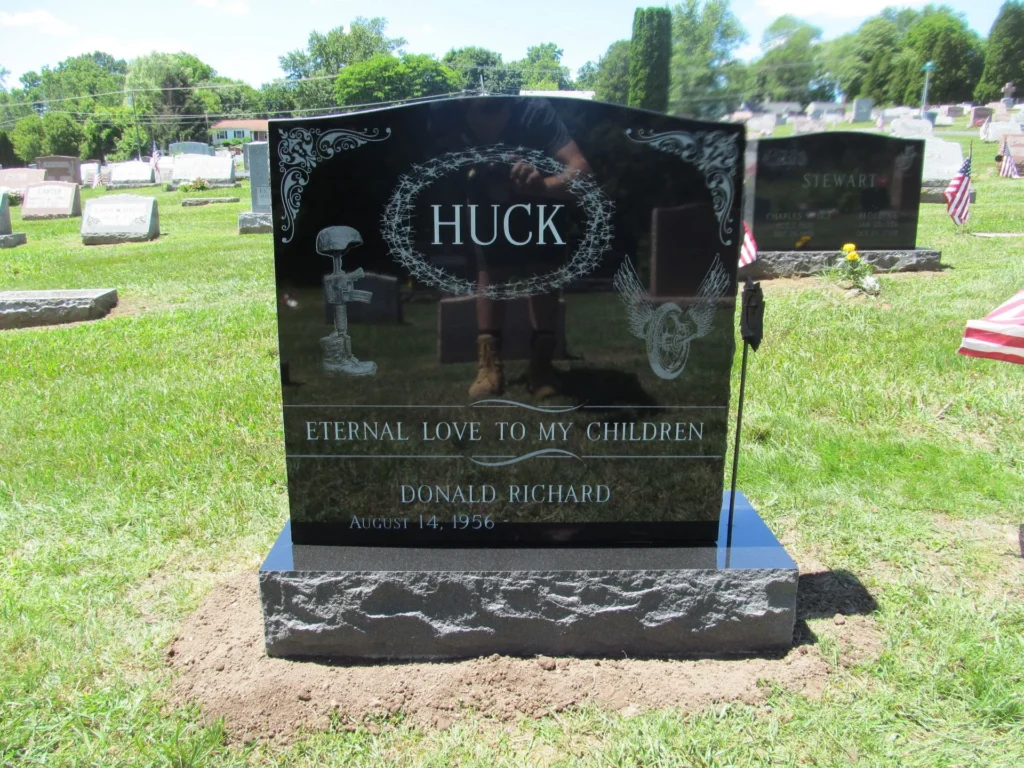
After the granite is cut, it’s ground with progressively finer abrasives. A final buffing with an extremely fine compound produces the mirror-like sheen that most people picture when they think of a modern headstone. That buffing step is also what amplifies the stone’s colour. A polished black granite looks richer and more vivid than the same stone left honed or rock pitched.
Water beads off a polished surface the way it does off a sealed countertop. Dirt doesn’t adhere, and cleaning usually needs nothing more than water and a soft brush. Polished granite also provides the highest contrast background for engraving. Laser-etched portraits, detailed scenes, and headstone etchings done in-house are all produced on dark polished granite, because the contrast between the polished surface and the exposed stone below is what makes fine detail visible. Without that contrast, the portrait flattens.
When morning light catches a polished black granite monument at an angle, the colour depth doesn’t translate to any sample card or website photo. Seeing it changes the decision for a lot of families.
A polished surface shows fingerprints, water spots, and seasonal pollen film more readily than any matte finish. In open cemeteries with hours of direct sun, a polished face can produce enough glare to make the inscription hard to read from a normal viewing distance. A frosted name panel behind the letters solves this, but it adds a step to the design conversation. Some heritage cemetery sections also restrict polished finishes to maintain visual continuity with older weathered markers nearby.
Polished works best for: dark granite colours, laser or hand-etched designs, formal memorial styles, and families who want a stone that stays crisp between occasional visits.
Honed Finish: The Matte Option Most Families Overlook
A honed finish is produced by stopping the polishing process before the final buff that creates a reflective sheen. The surface is smooth to the touch, exactly like polished, but light diffuses across it rather than reflecting off it. There is no shine. Honed suits traditional cemetery settings, lighter granite colours, and families who prefer a quieter, more natural appearance without the maintenance considerations that come with a high-gloss surface.
Most families who’ve heard the word honed haven’t had it properly explained. Here’s the thing: it feels identical to polished under your hand. The only difference is optical. Polished bounces light back. Honed absorbs it.
You’ll sometimes see steeled used in its place on order forms. Both produce a similar matte result, though through different processes: honed stops before the final buff, steeled blasts a polished surface with steel shot afterward. For practical purposes as a family making a finish choice, the visual outcome is close enough that the two words are effectively interchangeable.
On a south-facing stone in open sun on a bright afternoon, a polished face can make the inscription nearly unreadable from a few feet away. A honed surface doesn’t have that problem. The matte texture scatters the light instead of reflecting it straight back, so the lettering stays readable regardless of the sun angle. It’s also accepted in heritage and historic cemetery sections where polished finishes aren’t permitted, and it sits more comfortably next to older weathered markers than a mirror surface sometimes does.
The trade-off is slightly less colour saturation (roughly a shade more subtle than the same granite polished) and marginally less inscription contrast. Deep-cut sandblast lettering or a frosted panel behind the inscription compensates for this completely.
If the stone is a lighter grey and the setting is traditional or heritage, honed is usually the better fit. It doesn’t ask for attention. That restraint is often exactly what the moment calls for.
Rock Pitched Finish: Natural Texture That Goes on the Sides, Not the Face
Rock pitch is the only finish that’s hand-made. A craftsperson uses a hammer and chisel to chip the surface in a deliberate, controlled way, creating a rough, irregular texture that looks like stone in its uncut natural state.
Run your hand across rock-pitched sides and you feel the individual chips and ridges from the chisel work. No two surfaces are identical.
Rock pitch almost never appears on the engraving face of a monument. The front surface, where the name, dates, and any artwork live, is polished or honed so the engraving reads clearly. Engraving can’t be read cleanly against a rough, irregular background. Rock pitch belongs on the sides and top, where it frames the polished face rather than competing with it. In person, a smooth reflective front meeting a rough, jagged perimeter creates a contrast that photographs rarely capture fully.
In wooded, shaded, or informal cemetery settings, rock pitch fits the landscape the way no smooth surface does. It hides surface marks and minor weathering well, because there’s no shine to lose. It also carries a handcrafted character that no machine-finished surface can replicate.
That texture does collect debris and biological growth faster than smooth surfaces, though. Leaf matter, moss, and lichen settle into the crevices, particularly in damp or shaded conditions. A soft brush once a year clears most of it. For anything more persistent, the guide to removing moss growth covers the right method before you consider reaching for a pressure washer.
Manageable with periodic brushing. Not a reason to avoid it. Just something to know.
In the right cemetery setting, rock-pitched sides add a handcrafted dimension that polished or honed surfaces simply don’t have.
Two More Finish Terms Worth Knowing: Steeled and Frosted
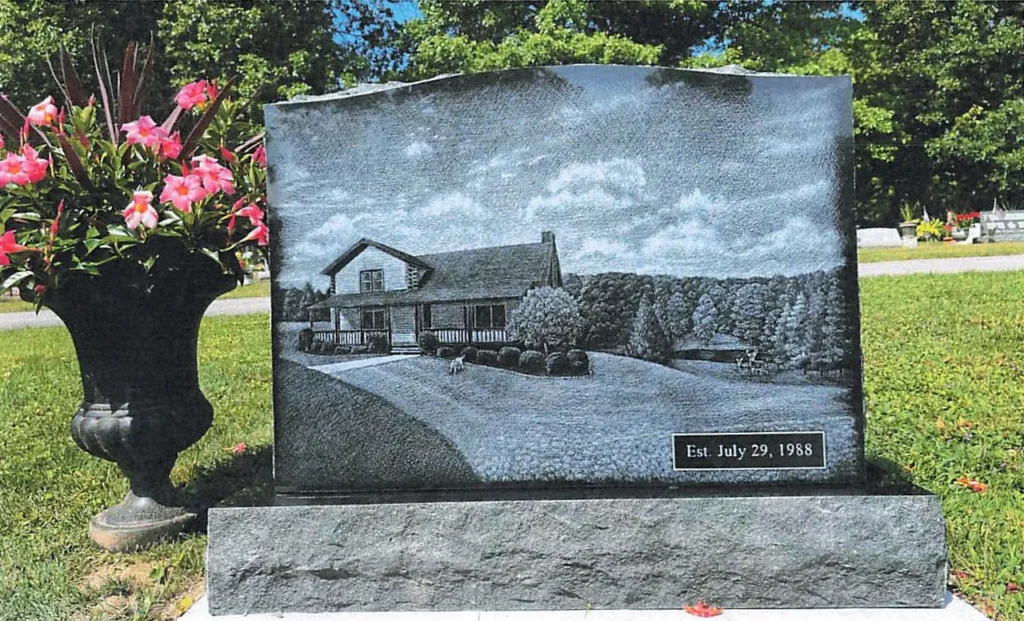
Steeled is a smooth matte surface produced by blasting a polished granite face with steel shot. The result looks nearly identical to honed. A frosted panel is a slightly recessed matte rectangle placed directly behind the inscription on an otherwise polished face; its job is to remove mirror glare so the engraving reads clearly from a normal viewing distance. Both terms appear on monument order forms and are worth recognising before you review your order.
Most families don’t notice the frosted panel as a separate element when they see a finished stone. They just notice that the name reads clearly in any light. That’s the panel doing its job quietly.
Steeled and honed surfaces both develop a natural patina as weather works the stone over the years. The surface gradually accepts the character of the outdoor environment it lives in. The tone shifts, picks up depth. It begins to look like it belongs to that specific spot.
Polished surfaces resist this and stay more uniform. Neither outcome is wrong. They’re just different relationships with how a memorial ages.
Why Most Monuments Use More Than One Finish
An upright monument has five exposed surfaces: front, back, left side, right side, and top. Most use at least two different finishes across those surfaces, and there’s a shorthand system on order forms that describes the combination.
The standard for a typical upright monument die and base is polished front and back with rock-pitched sides and top. On the order form, this appears as P2 BRP (two polished faces, Balanced Rock Pitched everywhere else). It’s the default starting point for most upright monument consultations, and it’s the combination you’ll see on the majority of granite headstones in WNY cemeteries. The table below translates the most common finish codes into plain language:
| Order Form Code | What It Means | Typically Used For |
| P2 BRP | Front and back polished, sides and top rock pitched | Standard upright monument die |
| P3 BRP | Front, back, and top polished, ends rock pitched | Upright die where a polished top is preferred |
| P5 / AP | All five exposed surfaces polished | Premium option; fully formal presentation |
| PFT BRP | Polished flat top, remaining sides rock pitched | Standard finish for monument bases |
| Steeled 2, Rock Pitch 3 | Front and back steeled/matte, sides and top rock pitched | Alternative to P2 BRP for a quieter overall look |
Most families at our showrooms choose P2 BRP for the die and PFT BRP for the base: polished where the engraving lives, rock pitched where the frame lives. You don’t need to memorise these codes. They’re here so the order form doesn’t feel like a foreign language when you’re reviewing it.
Want to see these finish combinations on actual stone rather than a table? All four Western New York showrooms have samples you can touch, compare side by side, and hold up to the light.
What Each Finish Says About the Person Being Remembered
Finish carries meaning beyond texture, and families sense this instinctively. A polished stone communicates something different from a rock-pitched one. Both are right for the right person.
A polished face reads as formal, colour-forward, and maintained. It pairs naturally with classic serif lettering, ornate designs, and a cemetery presence that says permanence and care. It’s a choice that reflects someone who valued presentation, or a family that wants the stone to stay sharp and recognisable across generations.
A honed or steeled surface reads as understated. It doesn’t compete for attention. It sits comfortably next to both century-old stones and recent ones, fitting well in mixed-era cemeteries and right for families who want the inscription to do all the talking.
Rock-pitched sides frame a memorial in craft and connection to the land. Combined with a nature-based design on a polished face (a farm scene, a hunting landscape, a river valley), the rough perimeter grounds the artwork in a way smooth sides simply don’t. For someone whose life was tied to Western New York’s landscape and working land, that framing carries real weight.
Which Finish Works Best with Which Engraving Method
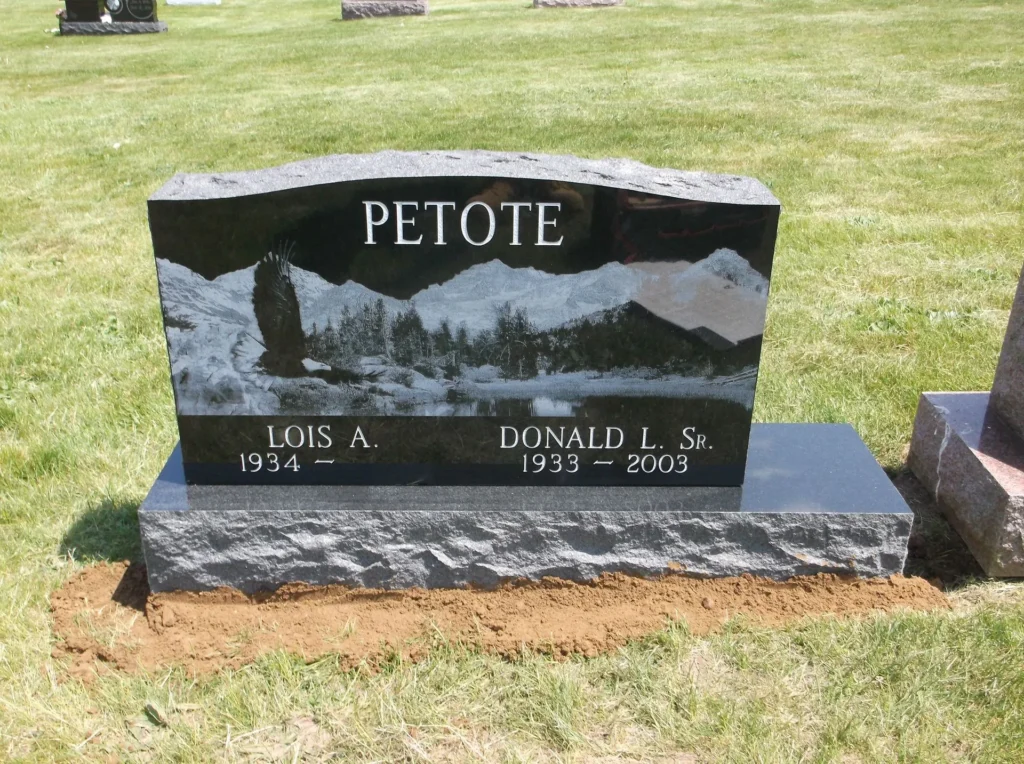
Dark polished granite is required for laser-etched portraits and in-house hand-etched artwork. The contrast between the polished surface and the exposed stone beneath is what creates the fine detail. Sandblast lettering works on polished or frosted/steeled faces. Deep V-cut letters pair well with a honed face. Rock pitch is never used as an engraving background. It belongs on sides and top as framing only.
Choosing a finish without knowing the engraving method first is working backwards. The two decisions are connected, and the wrong pairing produces a result that doesn’t look the way the family imagined it.
For laser-etched portraits and detailed scenes, the surface needs to be dark and polished. The laser removes a thin layer of that polished surface to expose the lighter, unpolished stone beneath. The contrast between the two is what produces portrait-level detail. On a honed surface or a lighter stone, that contrast disappears. The same applies to in-house hand-etched artwork, where the polish is what makes fine detail (faces, fur, landscape depth) legible against the stone. Our headstone etchings are done on dark polished granite for exactly this reason.
Traditional sandblast lettering is more forgiving. It works on polished, frosted, and steeled surfaces alike, because the contrast comes from the depth of the cut and the shadow it casts, not from the background sheen. Deep V-cut lettering paired with a honed face is a strong traditional combination: the matte surface cuts glare, the shadow from the cut provides all the contrast the letters need.
| Engraving Method | Surface Needed | Why It Works |
| Laser-etched portrait or scene | Dark polished granite | Contrast between polished and exposed lighter stone produces photographic detail |
| In-house hand-etched artwork | Dark polished granite | Same contrast principle; enables fully custom original work |
| Sandblast lettering | Polished or frosted/steeled face | Letter depth creates shadow contrast regardless of surface sheen |
| Deep V-cut lettering | Honed or polished with frosted panel | Shadow from cut depth provides contrast; honed eliminates glare |
| Rock pitched | Sides and top only | Not a readable engraving background; a framing texture |
Before settling on a finish, decide what will appear on the face. Seeing how the named granite colors interact with different finishes on actual stone samples makes this pairing decision much clearer than pictures allow.
How Western New York’s Climate Affects Your Finish Choice
Most national finish guides don’t address climate. For families in Western New York, that’s a real gap.
Granite handles cold weather well. Its water absorption rate typically runs between 0.05 and 0.4 percent, far below the threshold where freeze-thaw damage becomes a concern for the stone itself. (Dynamic Stone Tools, Natural Stone in Cold Climates guide.) The National Park Service similarly notes that granite’s low porosity means surface deterioration can be imperceptible for many years, even under constant outdoor exposure.
But finish type does change how moisture behaves at the surface, and that matters in WNY.
Polished surfaces shed water the way a sealed countertop does. After a WNY winter, a polished face typically needs a rinse and a soft brush. Rock-pitched sides hold moisture in their crevices longer. As that moisture cycles through the dozens of freeze-thaw events a typical WNY winter produces, it creates the damp surface conditions where moss, lichen, and algae establish most quickly. This is especially true in the wet weeks of April and May that follow the frost season. Manageable with periodic brushing. Not a reason to avoid rock pitch. Just something to know.
Lake-effect snowfall adds another layer. Heavy, wet lake-effect snow clings to rough textured surfaces longer than to smooth ones. As it melts and refreezes, it deposits organic material that feeds biological growth in spring. One brushing after winter handles it completely.
Families visiting in autumn and winter are working with completely different light than summer visitors. WNY has a high percentage of overcast days through the colder months. In that diffuse, indirect light, both honed and polished faces read clearly. The glare problems a polished stone produces in direct summer sun aren’t the everyday experience for most families visiting WNY cemeteries in October or November. Glare is a fair-weather consideration, not a year-round one.
For upright monuments in this region, the standard P2 BRP combination (polished face, rock-pitched sides and top) suits the climate well. The polished face stays clean and legible through wet seasons. The rock-pitched sides develop natural character that fits many WNY cemetery settings over time.
What Your Cemetery May Restrict Before You Decide
Cemetery regulations on finish are real. They vary by section (sometimes by row), not just by cemetery. Most WNY cemeteries are flexible for standard upright monuments in open lawn sections. But some situations have specific requirements.
Heritage and older sections sometimes require a matte or natural finish so stones sit visually alongside surrounding weathered markers. Some lawn sections specify that flat markers must have a polished top surface, because maintenance equipment passes directly over them and smooth is easier to manage. Cemetery rules are often written to include finish type in the approval submission alongside size and material.
Most families choose a finish they love before confirming what their section permits. In most cases this works out. But discovering a conflict after the order is placed adds time, and occasionally cost.
As part of the design process, we work directly with the cemetery to confirm what the specific section allows before the order is finalised. Finish compliance is a standard item we check. You don’t navigate that conversation alone.
Adding a Second Stone Later: Getting the Finish to Match
This comes up more often than families expect. A spouse’s stone was ordered ten or fifteen years ago. Now the companion stone needs to be ordered, or a second name and date needs to be added. The question is always: will it match?
A close match is usually achievable, but it depends on the right details. Polished surfaces are the most reproducible. The same granite colour ordered from the same quarry source, polished to the same standard, will come close to the original. Rock-pitched texture is harder to match exactly, because it’s hand-chiselled and each surface is slightly different. Most families read this as natural variation rather than a mismatch. It’s worth knowing before you expect a perfect replica.
Granite colour is actually the bigger matching variable. The same named colour can shift slightly between quarry batches over time. Finish is easier to replicate than exact colour tone.
If there’s an existing stone in the family, bring a current photograph to the consultation. Better yet, take one at the cemetery so the specialist can see the stone as it looks today, not as you remember it. That information makes the matching conversation much more accurate.
How to Choose the Right Finish in Four Questions
Start with these four questions: What does your cemetery allow? What engraving method are you planning? What direction does the plot face and how much shade does it get? Which granite colour are you drawn to? The answers will point to the right finish, or a combination of finishes, before you sit down with a specialist.
1. What does your cemetery allow?
Visit the section in person if you can, or ask the monument company to confirm the finish requirements for that specific area. Most WNY cemeteries are flexible for upright monuments, but heritage sections and certain lawn areas have rules worth confirming early. One conversation eliminates a potential problem down the line.
2. What engraving method are you planning?
If the design includes a laser-etched portrait, a detailed scene, or custom in-house hand-etched artwork, dark polished granite isn’t a preference. It’s a requirement. If you’re planning traditional sandblast lettering, polished or honed both work well. If you haven’t decided on the engraving yet, make that choice at the same time as the finish. The two decisions belong in the same conversation.
3. What’s the cemetery setting, and which direction does the plot face?
Visit the specific plot at two different times of day if possible. A south-facing stone in an open section gets direct sun for hours; a frosted name panel behind the inscription helps with legibility regardless of which face finish you choose. A north-facing stone under tree cover gets diffuse light. Honed or polished both read well there, and rock-pitched sides will develop a natural patina that suits the setting.
4. Which granite colour are you drawn to?
Colour and finish aren’t separate decisions. Dark granite (near-black, deep blue, mahogany) is at its most striking polished. Medium to lighter greys work well polished or honed; honed gives the stone a quieter, more organic presentation. If you’re still exploring colour options, seeing the named granite colors in person at the showroom is the best starting point. A small sample doesn’t show how a colour and finish combination reads in cemetery light.
Every finish decision connects to the stone’s colour, the engraving method, and the cemetery section. The easiest way to work through all three at once is in person, with actual stone samples in front of you. Tell us which cemetery you’re working with and we’ll confirm the finish requirements before the design goes to order.
Frequently Asked Questions About Granite Memorial Finishes
What does BRP mean on a monument order form?
BRP stands for Balanced Rock Pitched, the industry abbreviation for the hand-chiselled rough texture applied to monument surfaces. P2 BRP means two faces (typically front and back) are polished, with the remaining sides and top rock pitched. PFT BRP means the flat top of the base is polished, with rock-pitched sides. These two are the most common finish codes you’ll see on upright monument orders, and the table above explains the full set.
Does the finish affect how much the monument costs?
Yes. Polished surfaces require more manufacturing steps than rock pitched, so a P5 or all-polished monument carries a higher price than the standard P2 BRP. The difference between polished and honed on a single face is typically small. Finish gets factored into the quote during the consultation, with no surprises after.
Which finish is easiest to maintain over time?
Polished is the lowest-maintenance surface for the engraving face. Water and a soft brush handle routine cleaning, and dirt doesn’t penetrate the smooth surface. Rock-pitched sides benefit from an annual brushing, particularly where biological growth establishes during wet seasons. Honed sits between the two: slightly more effort than polished in damp conditions, but much less than rock-pitched.
Can the finish on an existing monument be changed?
Polished can be re-polished by a specialist with the right equipment. Rock pitch can’t be reversed; once chiselled, it can’t be smoothed back without removing significant stone material.
Do flat markers and upright headstones get the same finishes?
Not always by default. Flat markers typically have a polished top (the face visible from above) with sawn or rock-pitched sides. Upright monuments start from P2 BRP. Some cemeteries require flat markers to have a polished top because maintenance equipment passes directly over them. Your specialist will walk through the default finish for whatever style you’re considering, and flag any cemetery-specific requirements that apply.