
Granite holds up to decades of upstate New York winters better than almost any other material used in cemeteries. So when you notice a crack in a family monument, it’s worth understanding what actually caused it before deciding what to do next. Some cracks are stable and can wait a season. Others signal something structural that needs attention soon.
Granite memorials crack for several reasons, and the cause matters before any repair starts. The most common are freeze-thaw cycles, foundation movement from settling soil, and improper installation. In older monuments, corroding iron anchor pins can split granite from the inside out, a process called rust jacking that leaves rust stains at the base before any visible crack appears. A local monument company can assess the severity and handle cemetery coordination so families don’t have to figure that out on their own.
The Most Common Reasons a Granite Memorial Cracks
Water gets into the small pores of granite. In Western New York, winter temperatures drop below freezing repeatedly, and when water freezes, it expands by about 9% in volume. That expansion creates pressure inside the stone that granite can’t absorb without eventually cracking. When it thaws, the pressure releases. Then it freezes again. The Rochester to Batavia corridor sees more than 100 of these freeze-thaw cycles in a typical year, substantially more than climates farther south. Across enough winters, that repeated stress wears at the stone even when nothing else goes wrong.
Foundation problems are the second most common cause. A monument set on a base that wasn’t deep enough, or installed without accounting for frost heave, will start to shift. The ground freezes below the stone, expands upward, and pushes the monument out of alignment. When the soil settles again in spring, the monument doesn’t always return to its original position. That uneven pressure creates stress points in the stone, and cracks develop at those points over time. Soil settling beneath the burial itself is also a factor, particularly at older grave sites where the ground has been disturbed for decades.
Vandalism and physical impact happen less often, but they’re worth naming. A monument that gets hit by cemetery maintenance equipment, clipped by a branch during a storm, or deliberately damaged can develop cracks immediately or within a short time after the impact. Lawn equipment in particular accounts for more monument damage than most families realize, since the cemetery is responsible for grounds maintenance and those crews move quickly.
Biological growth plays a supporting role that’s often overlooked. Lichen roots can work into micro-cracks in granite and, given enough time, widen them. A monument that hasn’t been properly cleaned and maintained in many years is more vulnerable to this than one that’s maintained. It’s not the primary cause, but it’s a factor that compounds the others.
The Cause Most Families Don’t Know to Look For
There’s a less well-known cause of granite monument cracking that doesn’t come up in most conversations: rust jacking.
Many older monuments, particularly those set before the 1970s, were built with iron anchor pins inside. These pins connect sections of the stone or attach it to the base. When iron gets wet, it corrodes. And corroded iron doesn’t just weaken. It expands. Rust can occupy several times the volume of the original metal, and that expansion happens inside the granite, in a space with no room for it. The pressure builds until the stone cracks from the inside out.
The warning sign is easy to miss. Before any visible crack appears, brown or orange staining tends to show up around the base of the monument. Most families assume it’s water marks or soil staining. It isn’t. It’s rust bleeding through the stone, which usually means the iron inside is already corroding and the pressure is building. By the time the granite actually cracks, the internal damage has been progressing for a while.
Older monuments in cemeteries like Holy Sepulchre in Rochester or Mount Albion in Albion are worth examining carefully, especially if they were placed before stainless steel and epoxy dowels became standard practice. If you notice rust staining at the base of a family memorial, it’s worth having it assessed before the cracking starts rather than after.
How to Read the Crack You’re Looking At

Not every crack requires the same response. The difference between a hairline crack and a structural crack tells you how soon to act.
A hairline crack is a thin line on the surface of the stone, usually narrower than a credit card. In dense granite, a hairline crack can stay stable for years without getting worse, especially if the surface beneath it is still solid. It’s worth documenting and monitoring, but it doesn’t call for urgent action in most cases.
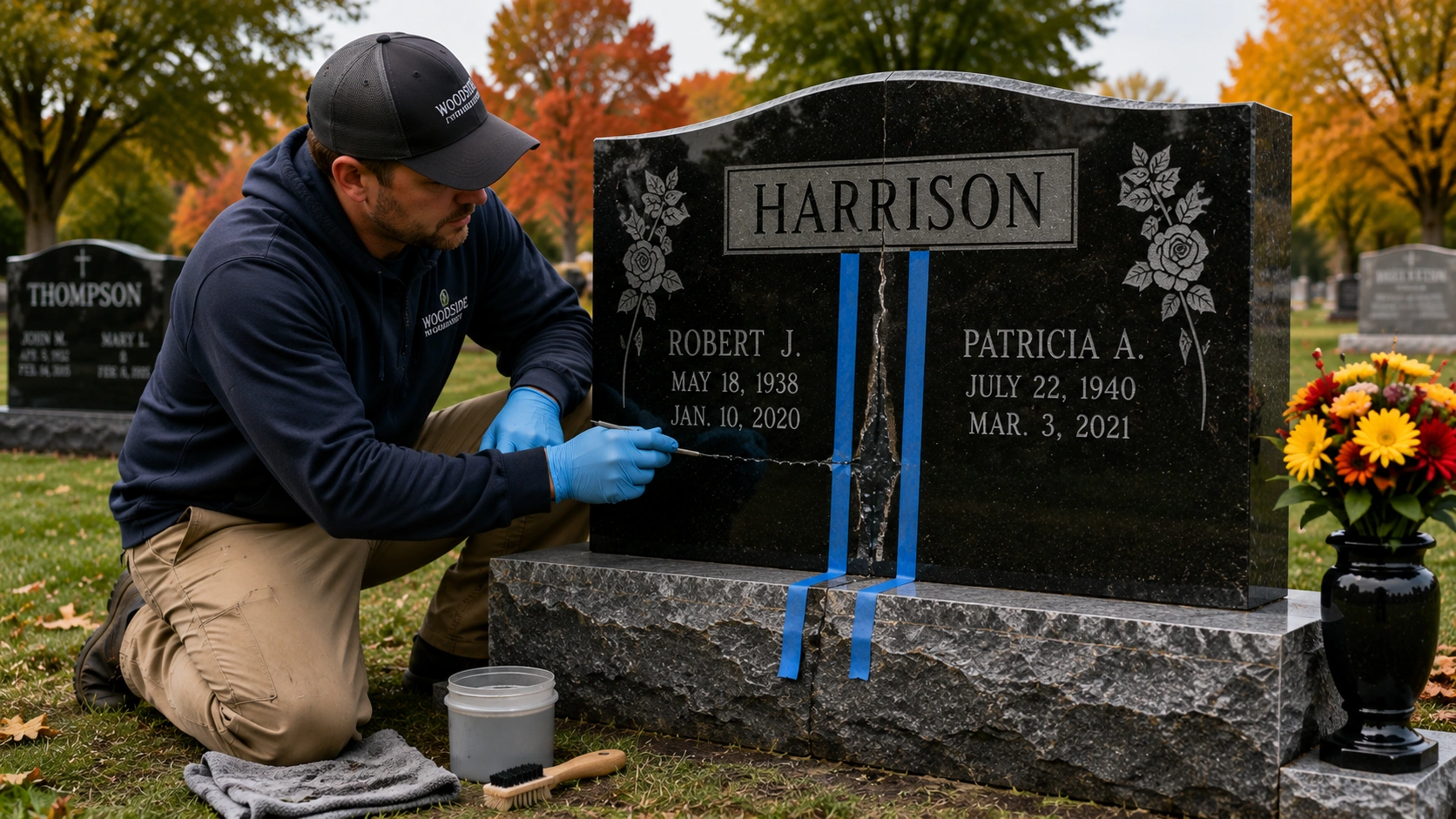
A structural crack is a different matter. This is a crack that penetrates through the stone itself, runs through the base where the monument connects to its foundation, or splits sections of the memorial apart. A monument with a structural crack at its base can become unstable and fall. That’s a genuine safety concern for anyone visiting the grave.
If you’re not certain how deep a crack goes, try tapping the surface lightly near it. Solid granite sounds solid. A hollow sound indicates that internal layers of the stone have separated, a condition called delamination. It isn’t always visible from the outside, but that hollow tap reveals it. If you hear anything hollow, don’t try to move, straighten, or repair the monument yourself. That’s the point to make a call.
Before contacting a monument company, take photographs. Get wide shots showing the monument in context, close-ups of the crack and the surrounding surface, and photos of the base where stone meets ground. If the damage appears recent or unexpected, photograph anything else around the site, disturbed soil, nearby tire tracks, broken pieces on the ground. That documentation helps with getting an accurate repair estimate and with any questions about cemetery or insurance responsibility that come up.
What Professional Repair Actually Looks Like

A professional assessment starts with understanding what caused the crack, not just what it looks like. The repair method depends entirely on the cause. Here’s what each scenario involves.
- Surface crack (shallow, no deep penetration). The crack is cleaned out, filled with a compound matched to the color and texture of the original granite, and sealed. Done early, this is the most straightforward type of repair. The fill material is matched closely to the surrounding stone, so the result is hard to notice at normal viewing distance.
- Structural crack or separated sections. The break surfaces are cleaned, the pieces are carefully aligned, and the stone is bonded with an outdoor stone epoxy. After the epoxy cures, the joint is filled and matched to the surrounding granite. A proper epoxy bond can end up stronger than the stone around it.
- Foundation movement or frost heave. Surface repair alone won’t hold if the ground hasn’t been corrected first. That means lifting the monument, addressing what’s underneath, and resetting it level and stable. Fixing only the visible crack without correcting the cause means the same movement will crack it again.
- Rust jacking (corroded iron pins). The corroded pins are removed, the interior is cleared out, and stainless steel or epoxy dowels replace them. That eliminates the source of the internal pressure.
Families often ask whether a repaired crack will still be visible. In most cases, a well-done crack repair on granite blends in closely with the original surface. No repair is completely invisible on close inspection, but from a normal viewing distance, the work shouldn’t stand out. The closer the match between the fill material and the original granite, the better the result.
Cemeteries require approval before any repair work begins. We handle that process directly with the cemetery, including permits, scheduling, and meeting whatever requirements they have for how the work gets done. Families dealing with a damaged monument usually don’t want to figure out cemetery administration at the same time. They don’t have to.
What Not to Do Before You Call
A few specific things to avoid before a professional has looked at the monument.
Don’t push, brace, or attempt to straighten a leaning stone by hand. A cracked monument is structurally compromised, and moving it the wrong way can cause further damage or cause it to fall.
Don’t apply household adhesives, concrete patch, or general construction epoxy to the crack. Products not designed for outdoor granite can trap moisture inside the stone, cause the crack to spread, or cure in a way that makes professional repair significantly harder. Most cemeteries also prohibit unauthorized repairs, and using the wrong materials can void any warranty that exists on the monument.
Don’t pressure-wash or improperly clean the stone, even around the crack before calling someone. High-pressure water forces moisture deeper into existing cracks. In Western New York’s freeze-thaw climate, that added moisture becomes ice in the next cold snap, and the crack worsens.
When Repair Makes More Sense Than Replacement
Repair is the right answer in most situations. Even significant cracks can be stabilized if they’re addressed before the monument separates completely or goes through several more winters without attention.
Replacement starts to make more sense when a crack runs completely through a structural section and the pieces can no longer be safely bonded, when a monument has been cracked and exposed through multiple harsh winters to the point that its internal structure can’t hold a repair, or when the total repair cost on a severely deteriorated stone approaches what a new memorial would cost. That comparison depends on the specific monument, the extent of the damage, the cemetery’s requirements, and the kind of repair needed. Those factors are different for every family. A free estimate gives you a clear picture before committing to either direction.
A note for families planning ahead: if no crack is visible yet but a monument is more than a few decades old, having it assessed for early freeze-thaw wear before winter is worth considering. Catching a developing problem before it becomes visible saves time and usually costs less to address.
Frequently Asked Questions
Can a cracked granite headstone be repaired?
Yes. Most cracked granite headstones can be professionally repaired if the damage is addressed early. Hairline cracks and many structural cracks can be stabilized using specialized stone epoxies and color-matched repair materials. If foundation movement or rusted anchor pins caused the damage, those issues should be corrected first to prevent future cracking.
How much does it cost to repair a granite headstone?
The cost depends on the size of the monument, the severity of the crack, and whether the foundation also needs repair. Minor surface crack repairs are generally less expensive than structural repairs or monument resetting. A professional inspection is the best way to determine the appropriate repair method and estimate.
Is it better to repair or replace a damaged headstone?
In most cases, repairing a granite headstone is more affordable and preserves the original memorial. Replacement is usually recommended only when the stone has extensive structural damage, multiple broken sections, or deterioration that makes a safe repair impossible.
What causes granite headstones to crack?
The most common causes include repeated freeze-thaw cycles, shifting foundations, soil settlement, accidental impact, vandalism, and corrosion of old iron anchor pins. Regular inspections can help identify small problems before they become major repairs.
Can I repair a cracked granite monument myself?
DIY repairs are not recommended. Household adhesives, concrete fillers, and construction epoxies can trap moisture, discolor the granite, and make professional restoration more difficult. If a monument is leaning or has a structural crack, avoid moving it and contact a monument restoration specialist for an assessment.