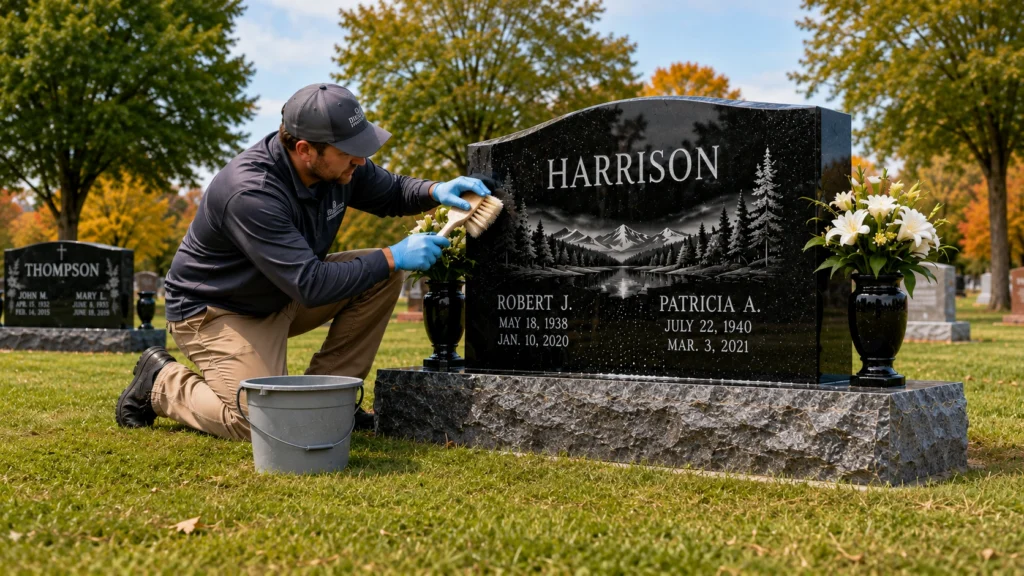
Granite is the most durable headstone material there is. It’s denser than marble, holds engraved detail sharper than limestone, and a properly cared-for polished granite memorial can stay readable for well over a century. But even the toughest stone collects biological growth, mineral staining, and weather buildup over time. Left alone, those things don’t just look bad; they slowly degrade the surface and soften the inscriptions.
The good news is that cleaning a granite memorial isn’t difficult when you use the right products and a little patience. The bad news is that some of the most common cleaning approaches (bleach, power washers, and a few popular internet tips) cause real damage that can’t be undone. This guide covers what actually works, what to avoid, and what families in Western New York specifically need to know about upstate winters.
Look for Damage Before You Start Cleaning
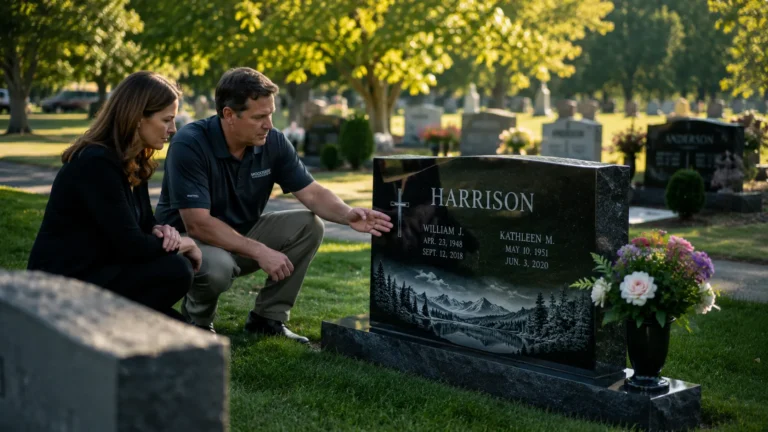
Run your hand gently across the surface before you bring water or cleaner near it. This takes about two minutes and can save you from doing real harm.
Look for a few specific things. Hairline cracks that have widened or deepened over the years. Any section of the surface that’s flaking, powdering, or feels rough in a way that doesn’t match the rest of the stone. A sandy, gritty texture that comes off on your fingers, which preservation experts sometimes call “sugaring” and which signals that the stone’s interior is deteriorating. And whether the stone shifts at all when you push gently with an open palm.
If the surface is actively flaking or the stone moves when you push it, cleaning isn’t the right step. Water and cleaner get absorbed differently by a deteriorating stone, and scrubbing can pull away material that can’t be replaced. That’s a restoration job, not a cleaning job.
A structurally sound stone with dirt, staining, or biological growth on the surface is exactly what this guide is for. If you’re not sure which situation you’re in, a photo sent to your nearest showroom is usually enough for us to give you a straight answer.
What to Bring and What to Avoid
Safe Tools and Cleaners to Use
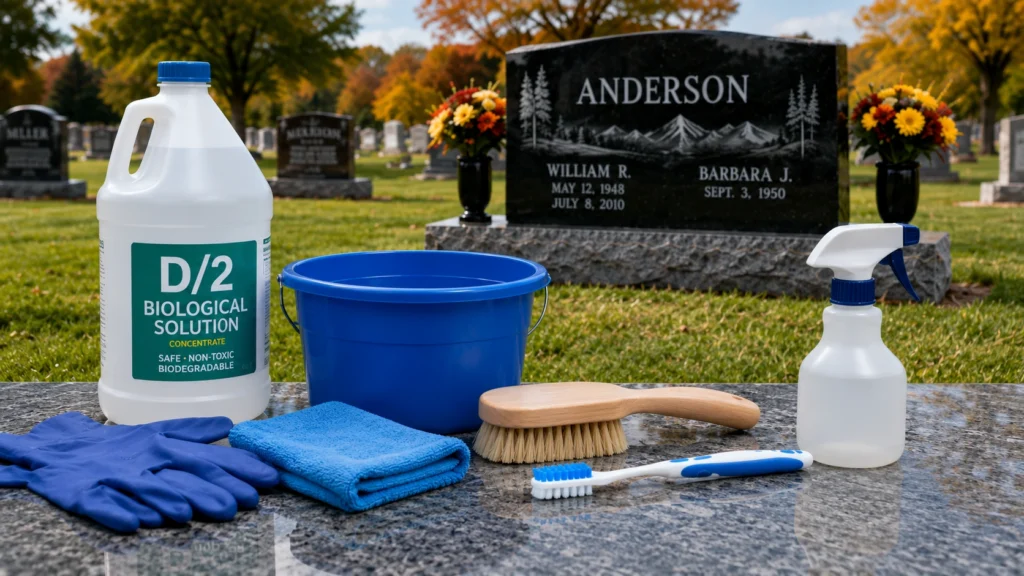
D/2 Biological Solution is what we’d recommend for any stone showing lichen, algae, mold, or mildew. It’s the cleaner the National Park Service uses for maintaining grave markers in national cemeteries, and it was validated through multi-phase testing by the National Center for Preservation Technology and Training. It kills biological growth at the root level rather than just washing it off the surface. It’s also pH-neutral and biodegradable, so it won’t harm the grass and plants around the stone.
You can order D/2 online through most major retailers. For routine cleaning where there’s no visible biological growth, a few drops of gentle dish soap in a bucket of clean water is a lighter-duty option that works fine.
Beyond the cleaner, you’ll need a soft-bristle brush, natural or nylon bristles, never wire. An old toothbrush is genuinely one of the most useful things you can bring; it gets into engraved letters in a way that a larger brush can’t. If the stone has significant lichen buildup, add a plastic scraper to your kit to lift the bulk before applying cleaner. Bring distilled water for the final rinse if you can, since it doesn’t leave mineral deposits behind the way tap water sometimes does. Rubber gloves are worth wearing if you’re using D/2, and a gallon jug of water handles the job at cemeteries that don’t have an accessible faucet.
Products That Damage Granite Headstones
- Bleach has a pH around 13. Granite is porous enough to absorb it, and once it’s in the stone it causes brown discoloration and weakens the surface over time. It also kills the surrounding grass.
- Vinegar is acidic. It etches polished granite finishes and can dissolve the natural surface on softer finishes. It’s useful for a lot of household cleaning tasks. Headstone cleaning isn’t one of them.
- Pressure washers erode engraved lettering even at low pressure settings. They also force water deep into hairline cracks. In Western New York, where winter freeze-thaw cycles are a real threat, any water sitting inside a crack is a problem that compounds with every cold night.
- Wire brushes leave metal particles embedded in the stone. Those particles rust. The result is permanent orange staining.
- Shaving cream has circulated online as a way to make faded inscriptions temporarily readable. Preservation experts are consistent on this: the chemical compounds in shaving cream accelerate stone deterioration with repeated use. It’s not worth it.
- Ammonia-based cleaners carry the same etching risk as acidic products. Check the label on anything before you bring it.
How to Clean a Granite Headstone, Step by Step
1. Call the cemetery office first.
Some cemeteries prohibit specific cleaning products. Others ask that family members let them know before working on a marker. A two-minute call prevents a problem. When we handle monument placement at any of our Western New York showrooms, cemetery coordination is part of what we do. For a cleaning visit on your own, checking in is your responsibility, and it’s a quick one.
2. Wet the entire surface before anything else touches it.
Soak the stone thoroughly before applying any cleaner. This loosens surface dirt and keeps the cleaner from absorbing unevenly into dry or warm stone. Pour water gently from your jug or use a slow hose. Don’t spray at pressure even here.
3. Apply D/2 Biological Solution to the wet stone.
Apply it directly and let it sit for 5 to 10 minutes before you scrub. This dwell time matters. D/2 works by breaking down the biological organism at the root; it needs time on the surface to do that. For heavy lichen buildup, use the plastic scraper to carefully lift the bulk of the growth before applying the cleaner. Never use a metal scraper.
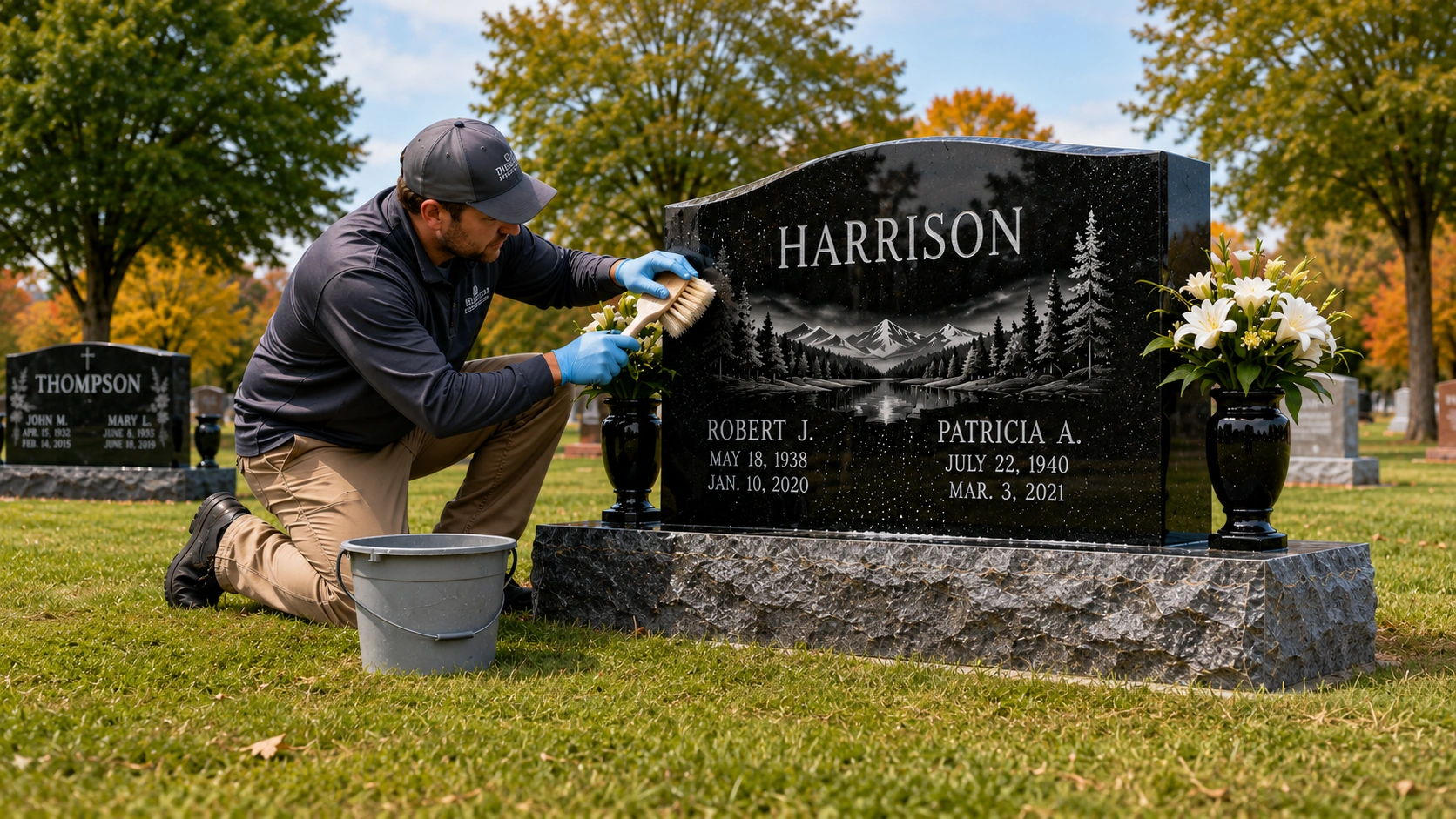
4. Scrub with a soft-bristle brush in small circular motions, working bottom to top.
Starting at the base and working upward keeps dirty rinse water from running down over sections you’ve already cleaned. Use light, consistent pressure. The goal is to lift material off the surface, not force it into the stone.
5. Clean the engraved letters separately.
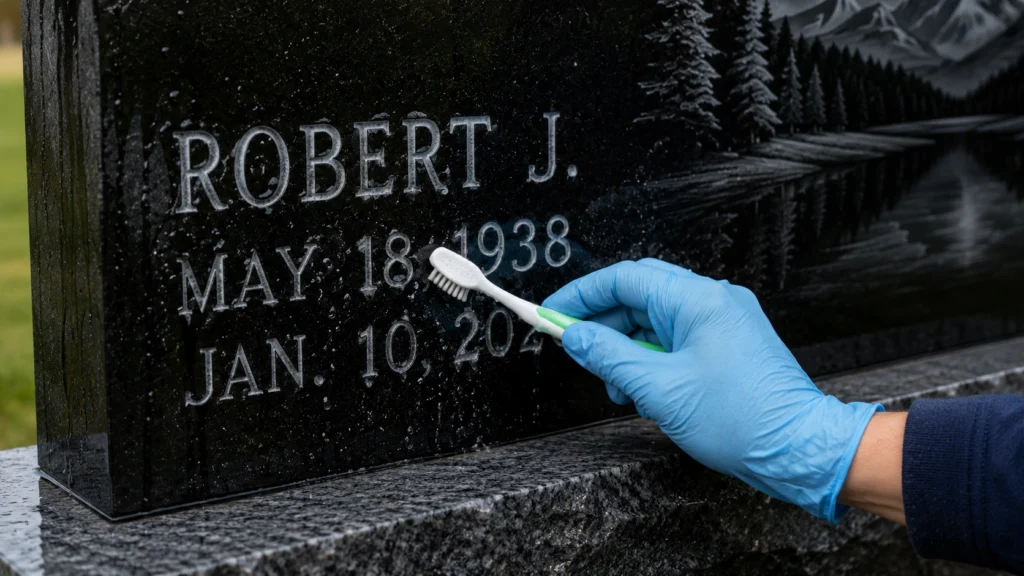
Engraved letters collect more dirt and biological growth than the flat surface does. Switch to the toothbrush here and work gently along each letter with a little D/2. Cotton swabs reach the tight corners. Don’t press hard enough to widen the carved grooves; the cuts in granite are precise and you want to keep them that way.
6. Rinse completely.
Pour clean water over the full surface until all cleaner and loosened material is gone. Leftover cleaner residue attracts new dirt faster than an unclean surface would. Don’t cut this step short. If your jug runs low, prioritize a thorough rinse over a second scrub pass.
7. Let the stone air dry completely.
D/2 keeps working for several weeks after you apply it. You’ll often see biological die-off continue as the stone dries and after the next few rainfalls. The surface may look slightly hazy for a few weeks. That’s the cleaner finishing its work, not a sign that something went wrong. Come back in about a month for a light follow-up clean if the stone still has patches.
How to Handle Tough Stains on Granite
Green and Crusty Growth (Lichen) Takes More Than One Visit
Lichen is a combined algae-and-fungi organism. It grows root-like structures called holdfasts that grip the stone’s surface and penetrate it slightly, which is why scrubbing alone doesn’t remove it. The organism itself has to be killed before it releases.
Apply D/2 undiluted, wait 15 minutes, apply a second coat, wait another 15 minutes, then scrub gently with a soft brush. Even after that, the lichen won’t clear completely in one visit, and that’s fine. D/2 kills the organism at the root, and the dead material releases from the stone over the following four to six weeks as it dries out and gets rained on. Plan to return about a month later for a follow-up clean. Most of what remains will rinse off easily by then.
One more thing: resist the urge to chip or scrape lichen off with anything metal. Wire tools leave particles behind that rust and stain, and the force can damage the polished surface underneath.
White Film and Chalky Spots from Sprinkler Water
Cemeteries with automated irrigation often leave white or hazy calcium deposits on markers over time. The sprinkler hits the stone, the water evaporates, and the minerals stay behind.
Start with distilled water and gentle scrubbing. Tap water adds its own minerals to the problem, so use distilled for this one specifically. For deposits that don’t respond to that, a paste of baking soda and water applied gently and rinsed off thoroughly can help break them down. Avoid acidic solutions even for mineral staining; the risk of surface etching is real and the results can be irreversible.
Orange or Brown Rust Stains
Orange or brown staining on granite almost always comes from metal objects near the stone. Common culprits are flower holders, flag mounts, wire candle holders, and wire brush residue. A stone-safe iron removal product handles most rust staining when used according to the manufacturer’s directions; rinse the area thoroughly afterward. If the staining has been sitting for years and appears to go deep into the surface, professional assessment is the more honest answer than another round of cleaning.
Why Does the Stone Look Darker After Rain?
Granite is porous, even the polished kind. When it gets wet, it absorbs a small amount of water, and the color deepens and intensifies temporarily. Some areas may dry faster than others, which can make the stone look uneven for a few hours.
This is normal. As the stone dries over the course of a few hours to a full day, it returns to its natural color. The color shift isn’t damage and doesn’t need to be treated.
If the stone is staying dark in one spot for more than a day after rain, or if it dries to a noticeably different color than it used to, that can point to a moisture problem worth having a monument specialist look at.
When to Clean a Headstone in Western New York
Most granite memorials stay in good shape with one or two cleanings a year. A stone that sits under trees or in a low spot that holds moisture benefits from a third cleaning, since those conditions speed up biological growth significantly.
The best conditions for cleaning are a cool, overcast day with no rain expected for several hours. Early morning is better than midday. Spring after the final hard freeze and early fall before temperatures start dropping are the two most reliable windows.
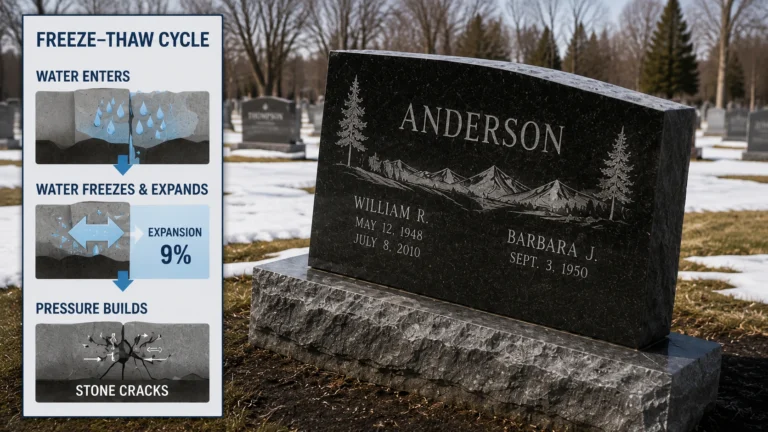
In Western New York, the freeze-thaw timing is more critical than in most of the country. Upstate winters push water into the pores and cracks of stone, and when that water freezes it expands. Repeated cycles of freezing and thawing are one of the main reasons older monuments tilt, crack, and eventually need restoration work. Any moisture introduced during cleaning that isn’t fully dry before a hard freeze becomes part of that problem.
The rule is simple: don’t clean a headstone when freezing temperatures are expected within the next 48 hours. In Western New York, that window runs from roughly mid-October through late April. If you want to clean in the fall, early October is safer than waiting until the end of the month. If Memorial Day is your usual time for this, plan to go out in late April or early May, before cemetery traffic peaks and before the summer heat arrives.
Speaking of heat: if a stone has been sitting in direct afternoon sun and the surface feels warm to the touch, pour cold water on it slowly rather than splashing it. The sudden temperature difference can cause hairline surface cracking. Early morning is the right time to clean in July or August.
Signs the Stone Needs Professional Restoration, Not Just Cleaning
Regular cleaning maintains a stone’s appearance and slows deterioration. It doesn’t address structural problems.
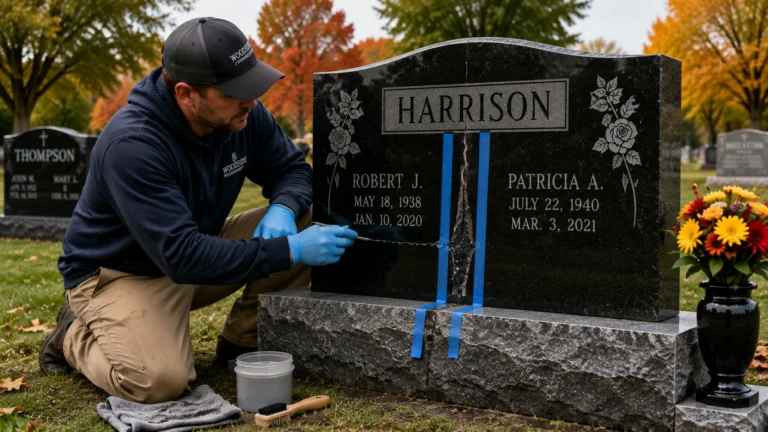
If cracks in the stone have widened or deepened, that’s a repair job. If engraved letters have softened, faded, or are missing material, that’s re-engraving work. If the stone is leaning, tilted, or sinking unevenly, the foundation or setting needs professional attention, not a scrub brush.
These things happen over time, and they happen more often in climates like ours. We’ve handled monument restoration across all four of our Western New York locations, covering everything from natural freeze-thaw damage and biological deterioration to vandalism and impact damage. The line between what a family can take care of at home and what requires a professional is almost always clear once someone with experience takes a look at it.
Common Questions About Cleaning a Granite Headstone
Can I clean a headstone that isn’t my family’s?
For historical preservation or volunteer work, yes, with permission from the cemetery administration and, where possible, from the family. For any stone you have no direct connection to, the cemetery office is always the right starting point.
Will cleaning damage the stone if I do it wrong?
Done correctly with soft tools and a gentle pH-neutral cleaner, no. Done with bleach, vinegar, a pressure washer, or a wire brush, yes, and some of that damage can’t be reversed. The cleaning itself isn’t risky; the wrong products are.
Should I seal the stone after cleaning?
Most conservation professionals recommend against applying sealants or wax coatings to cemetery headstones. These products can trap moisture inside the stone, which makes freeze-thaw damage worse rather than better. Some coatings also yellow over time. If you want to discuss a specific stone, talk to a monument specialist before applying anything.
How long does a cleaning take?
A routine cleaning with no significant biological growth runs about 30 to 45 minutes. A stone with heavy lichen that needs two D/2 applications takes 60 to 90 minutes on-site, plus a follow-up visit about a month later. Stones that haven’t been cleaned in many years may need a second full cleaning a few weeks after the first.