Choosing a headstone starts with the cemetery, not the catalog. Confirm what your cemetery allows for size, material, and color before anything else. From there, the real decisions are type (upright, flat, bevel, or slant), material (granite, marble, or bronze), and personalization (color, etching, and wording). Granite remains the most durable modern choice for most families, and the order you make these decisions in usually determines whether the process feels smooth or frustrating.
You’ll probably only go through this once or twice in your life, so it’s worth doing in the right order. This guide walks through that order step by step, with a short, complete answer to every major decision and a link to a deeper comparison wherever you want to go further.
Start With the Cemetery’s Rules, Not the Stone
Most families start by picking a shape, a color, or a price point. That’s backward. The cemetery decides what’s actually possible before personal preference gets a vote.
Every cemetery sets its own rules, and they vary more than most people expect. Some sections only allow flat or flush markers because that lets a mower pass straight over them without anyone having to trim around an upright stone. Others cap height and width so one memorial doesn’t overshadow its neighbors. A handful won’t accept certain materials at all, and some sections restrict color to keep a uniform look across the grounds. None of this is universal. What’s standard at one cemetery can be against the rules two miles away.
Here’s the part that catches families off guard. A headstone can be fully designed, approved by the family, and paid for, and still get rejected if nobody checked the cemetery’s written rules first. That’s not a rare story. It’s the single most preventable delay in the entire process. We get written confirmation of a cemetery’s requirements, and written approval of the actual design, before production starts rather than after, specifically to avoid it.
That coordination step is also the part most companies quietly leave to the family. We don’t. Contacting the cemetery directly is built into how we work on every order, not something we add only if you ask for it.
Why Working With a Company That Already Knows Your Cemetery Saves Weeks
Cemetery familiarity isn’t something a company can fake, and not every company has it. A monument maker who has already set hundreds of stones at one cemetery knows where the rules run stricter than the website lets on, which sections require flush markers, and roughly how long approval takes there. A company starting from zero has to learn all of that during your order, while the clock is already running. We’ve put together a full breakdown of New York cemetery monument rules if you want to see how much this actually varies from one cemetery to the next.
This is exactly why it matters which showroom you’re closest to. We’re right next door to Holy Sepulchre Cemetery’s monument guidelines through Hart Monument Company in Rochester, and the same goes for Brigden Memorials and Mount Albion Cemetery’s rules in Albion. Carmichael and Reed Monument Company has that same relationship with Warsaw-area cemetery rules, and Oakley Monument Company already knows what Batavia’s cemeteries require. Whichever showroom is closest to you, the cemetery coordination happens the same way: directly, before production starts, not after.
Granite, Marble, or Bronze: Which Material Actually Holds Up

Granite resists weathering, biological staining, and cracking far longer than marble. Marble is softer and more porous, and it discolors faster, which matters specifically in a freeze-thaw climate like Western New York’s, where the ground heaves and settles every winter. That single fact explains most of why granite dominates new memorials today.
Bronze is the other material families ask about. It’s cast metal, standard for flat markers and many VA and military markers, and it’s mounted on a granite base rather than standing on its own. Over time, bronze develops a natural patina, a soft greenish-brown shift in color that many families find beautiful rather than something to prevent. It can be polished back to a brighter finish if that’s the look you’d rather keep.
Granite’s hardness is also exactly why custom carving historically took longer in granite than in softer stone. Modern cutting and engraving equipment has narrowed that gap a lot, but full hand etching still takes longer than a standard inscription, regardless of which material you choose. We’ll get into that trade-off in the etching section below.
You’ll still see limestone, sandstone, and slate mentioned on older memorials, especially in cemeteries with sections dating back to the 1800s. That’s worth knowing if you’re researching family history, but these materials have largely been replaced by granite for new memorials because they weather faster and carve less precisely with modern tools.
| Material | Durability | Typical Use | Maintenance |
|---|---|---|---|
| Granite | Highest. Resists weathering for generations | Upright, flat, bevel, and slant memorials | Occasional cleaning with water and a soft brush |
| Marble | Moderate. Softer and more porous | Older memorials, some companion designs | More frequent cleaning, more vulnerable to staining |
| Bronze | High. Develops a natural patina | Flat markers, VA and military markers | Periodic polishing if you want to keep a bright finish |
Choosing the Right Type of Memorial for Your Family
Type affects both how a memorial looks and what your cemetery will accept, which is why it’s worth deciding right after material rather than jumping straight to color and wording. Here are the four decision points most families actually face, roughly in the order they come up.
Upright vs Flat Headstones
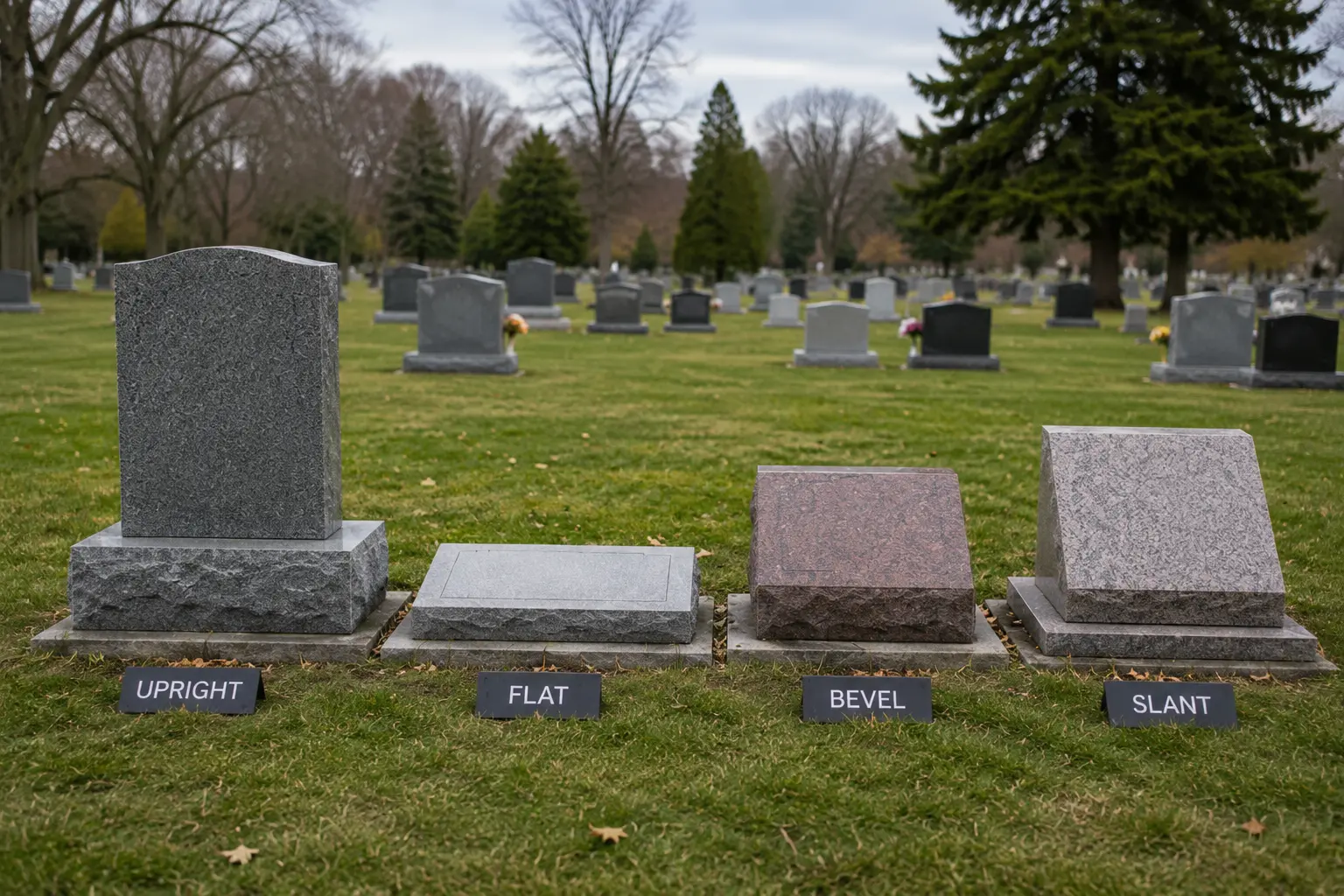
Upright headstones are the traditional vertical tablet on a base. They offer the most surface area for engraving and stand out the most at the gravesite. Flat markers sit flush with the ground, which some cemetery sections require specifically to simplify mowing and groundskeeping. Flat markers also tend to cost less than upright monuments of comparable size.
What Is a Bevel Marker
A bevel marker sits between a flat marker and an upright monument. It’s raised slightly off the ground with a cut angle, so it reads more clearly from a few steps away than a flush marker does, without the height or footprint of a full upright stone. Families who want more presence than a flat marker but aren’t drawn to a tall upright monument often land here.
What Is a Slant Marker
Slant markers typically stand 12 to 16 inches tall with a slanted face. They give you a lower profile than upright but more visibility than flat or bevel. We design and engrave these in-house, the same way we handle our upright work.
Companion vs Single Headstones
A companion, or double, headstone is built for two people, usually spouses. The layout matters here in a way it doesn’t for a single stone. If one person’s name and dates will be added later, the design needs to leave balanced space from day one, not as an afterthought once the second date is known.
| Type | Visibility | Typical Cemetery Fit | Worth Knowing |
|---|---|---|---|
| Upright | Highest | Traditional sections with the most room for inscriptions | Usually costs more, due to size and the base |
| Flat | Lowest | Required in many maintenance-focused sections | Usually the most affordable option |
| Bevel | Medium | Accepted where flat is required but more visibility is wanted | A middle ground, not a compromise |
| Slant | Medium | Sections that allow some height but not full upright | Smaller footprint than upright, more presence than flat |
Beyond the Headstone: Benches, Boulders, and Columbarium Niches
Not every family wants a traditional marker, and cemetery rules in some sections actually call for something other than a standard headstone.
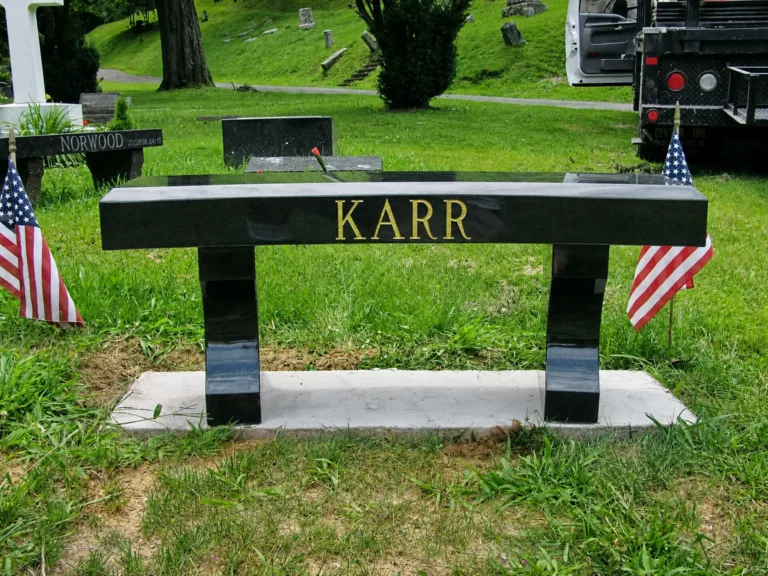
Memorial benches are granite benches built for a cemetery, a garden, or a home, with room for inscriptions, a quote, or a symbol. They double as something functional. People can sit at one, not just look at it.
Memorial boulders are natural rock, sawn flat on one face and engraved, available polished or left in a more natural, unpolished finish. They’re less common than a shaped headstone, which is exactly why some families choose one, for a rustic look that doesn’t read as a standard catalog shape.
A columbarium is an above-ground structure with cremation niches, and it scales from a small two-niche family unit up to many rows for a larger cemetery installation. A mausoleum is a different thing entirely: an individual or family above-ground structure, custom-designed or pre-built, and it sits at the top of the price range for memorial options.
Picking a Granite Color That Still Reads Clearly in 50 Years
Granite color affects how well an engraving stays legible from a distance, not just how the stone looks the day it’s installed. That’s the part most people don’t think about until it’s pointed out.
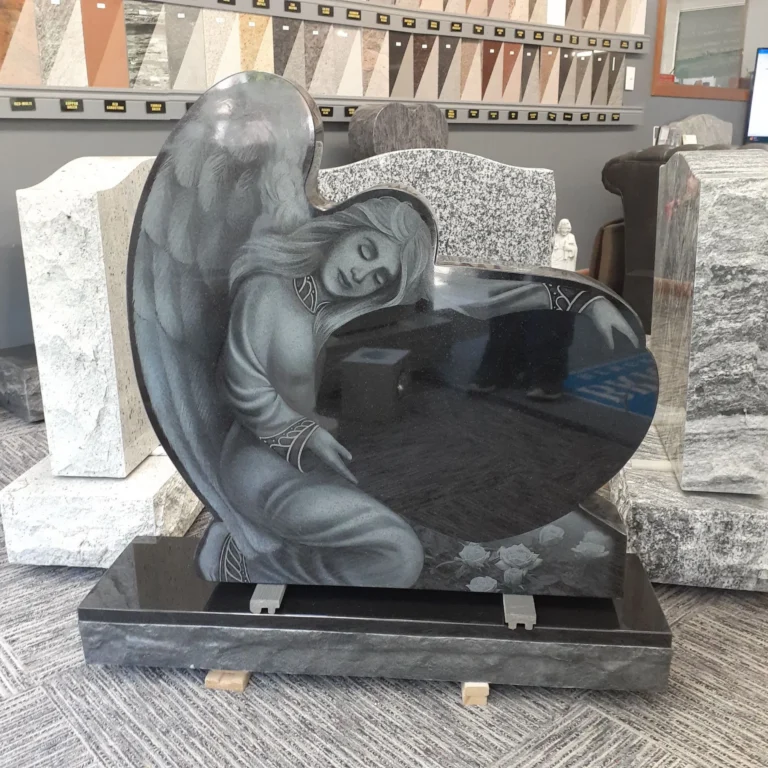
Black granite is the only practical choice for laser-etched photographic detail, because it gives the highest contrast for fine line work and shading. Lighter or more exotic colors can still carry a photo or portrait, but they sometimes need painted lettering afterward just to stay visible at a glance.
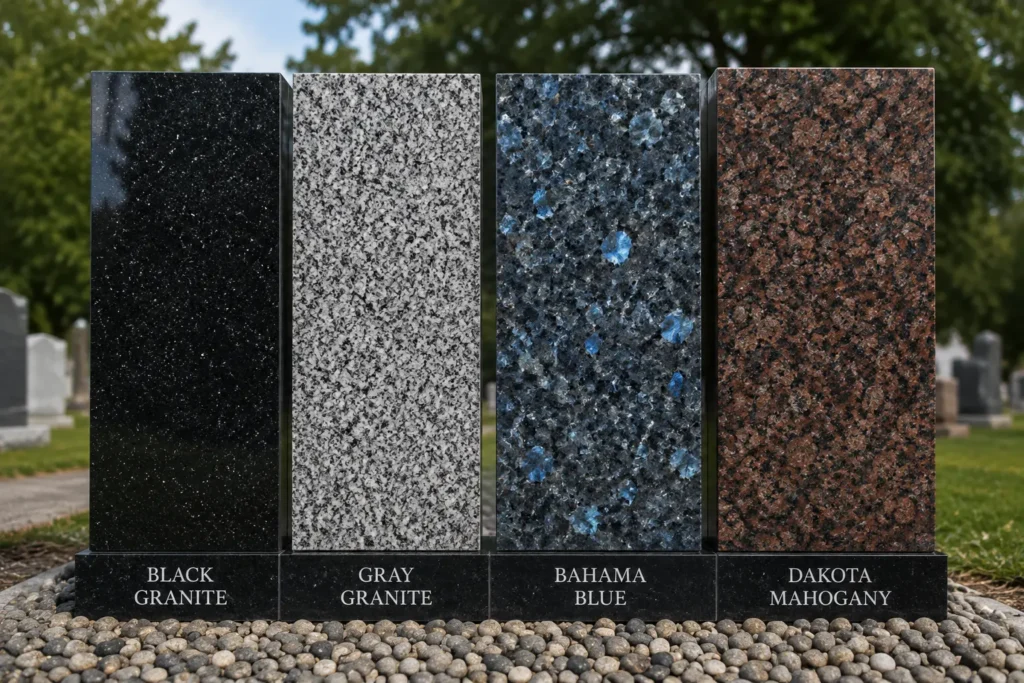
We carry more than 90 named granite colors across all four of our showrooms, from Academy Black and Bahama Blue to Dakota Mahogany and beyond, so the color you want isn’t limited by which location you happen to visit. One family who chose Bahama Blue for their loved one’s memorial told us they “haven’t seen any like it,” which is true of a lot of the colors in the catalog once you see them in person rather than on a screen.
Hand Etching vs Laser Etching, and Why the Artist Matters

Laser etching is machine-driven and precise. It’s well suited to reproducing a photograph in fine detail, especially on black granite. Hand etching is different. It’s done directly into the stone by an artist, working freehand rather than from a fixed image file, which means it can go beyond reproducing a photo into a fully custom scene, a portrait built from several reference photos, or artwork that doesn’t exist anywhere else.
Our Artist-in-Residence, Melissa Trinidad, recruited from Georgia’s stone quarries, does this kind of hand etching, including portraits and custom farm scenes for families who want something a camera alone couldn’t capture. It takes longer than laser etching, and it costs more. We’d rather tell you that upfront than let you find out partway through.
If You’re Commissioning a Civic or Veteran Memorial, the Process Looks Different
Civic and institutional commissions, for a police department, a union local, a municipality, or a veteran or tribal organization, follow a different approval path than a single family making an at-need purchase. Most of the time, that means sign-off from a board or committee rather than one person’s decision, and a longer runway between the first conversation and a finished design.
Veterans have their own path as well. The VA furnishes a government headstone or marker for many eligible veterans and dependents, often at no cost to the family. Eligibility, inscription rules, and whether a government marker can be combined with a private memorial all vary by situation, so we’ll keep this short and point you to the full breakdown: VA headstone and marker benefits explained.
We’ve worked on civic and institutional commissions before, and the same in-house design and manufacturing process applies, just with a different sign-off process layered on top. If your organization is planning something similar, read more about civic and veteran monument materials and design.
Wording the Headstone: Why Rushing the Epitaph Is the Most Common Regret

There’s no required timeline for finalizing the wording on a headstone, and a lot of families wait several months before they’re ready to commit to it. Rushing the epitaph while grief is still raw is one of the most common regrets we hear about, and it’s almost never necessary.
Disagreement is normal too. Siblings, a surviving spouse, or parents sometimes want different things on the stone, different symbols, a different tone, even a different amount of detail. That doesn’t mean something has gone wrong in your family. It usually just means everyone needs a bit more time to land somewhere together, and taking that time is worth it.
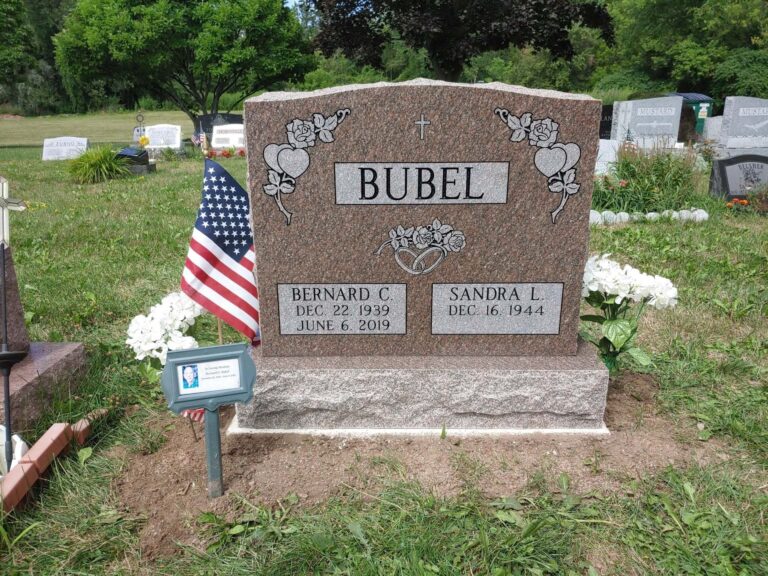
Most stones include, at minimum, a name and birth and death dates. From there, families add a relationship line, a short phrase, a religious or military symbol, or a quote that meant something to the person being remembered. One thing worth knowing from people who’ve cut a lot of lettering into stone: a shorter inscription almost always reads more clearly and ages better visually than one that tries to fit too much in.
What It Actually Costs and How Long It Actually Takes
A headstone typically costs $350 to $10,000 or more and takes six weeks to several months to install. Simple flat or bevel markers in common granite colors run $350 to $1,500 and take 6 to 8 weeks. Custom upright monuments, hand etching, or companion headstones run $5,000 to $10,000-plus and take 3 to 6 months. Western New York winters can add weeks to outdoor installation.
Common Mistakes Families Make When Choosing a Headstone
A few patterns show up again and again, and most of them are easy to avoid once you know to watch for them.
- Choosing a design or size before confirming the cemetery’s rules. This is the single most common cause of a rejected or delayed order, and it’s almost entirely avoidable. Check first, design second.
- Finalizing the wording too quickly while grief is still raw. It’s understandable to want to feel finished with one more decision, but this is the one to slow down on. See why waiting on the wording is worth it.
- Overcrowding the inscription. More words on the stone doesn’t mean more meaning. It usually just means smaller letters and a harder read from a few feet away.
- Assuming you have to coordinate with the cemetery yourself. Some companies leave that step entirely to the family. Ask upfront whether the monument company will handle it directly, since that one question can avoid the most common cause of rejection before it ever becomes a problem.
- Picking a granite color from a small sample chip alone. A two-inch swatch doesn’t show you how lettering will actually look once it’s engraved into a full-sized stone. Ask to see a larger sample or a finished example in that color if you can.
Questions to Ask Before You Choose a Monument Company
A short list, worth having ready before your first conversation:
- Do you design and letter the memorial in-house, or send the work out to someone else?
- Will you contact the cemetery directly, or is that left to us?
- Can you show me real examples of work in a similar material or style?
- What’s the actual production and installation timeline, in writing, not a rough verbal estimate?
The last one matters more than it sounds like it should. We’ve heard from plenty of families who chose us specifically because the consultation felt like guidance, not a sales pitch, no pressure to decide on the spot and no upsell toward something they didn’t ask about. After your headstone is set, we also send a confirming photo so you know, without a special trip out to the cemetery, that everything looks the way you approved it. If that’s the kind of process you’re looking for, speak with us about a free estimate.
Frequently Asked Questions
What’s the difference between a headstone and a grave marker?
“Headstone” usually refers to an upright stone at the head of the grave, while “grave marker” is a broader term that covers flat, bevel, and bronze markers set flush or near-flush with the ground. Most families use the two terms interchangeably, and that’s fine.
What’s the most popular color for headstones?
Gray and black granite remain the most popular choices. Gray is widely available and affordable without sacrificing quality, while black granite is the top pick whenever a family wants laser-etched photo detail, since it gives the strongest contrast.
How long after burial should you wait to get a headstone installed?
There’s no waiting period required to order or design a headstone. Setting the foundation is a separate matter. Many cemeteries ask families to wait while the ground naturally settles, often six months to a year, before an upright monument goes in, so the foundation has something stable underneath it. Flat markers can sometimes be set sooner.
What side should a husband and wife be buried on?
Traditions vary by religion, region, and cemetery, so there’s no single universal rule. In many Christian traditions, the husband is buried on the right when facing the headstone and the wife on the left, but this isn’t required anywhere we’ve worked. If you’re planning a companion headstone, your cemetery can confirm any layout expectations specific to that section.